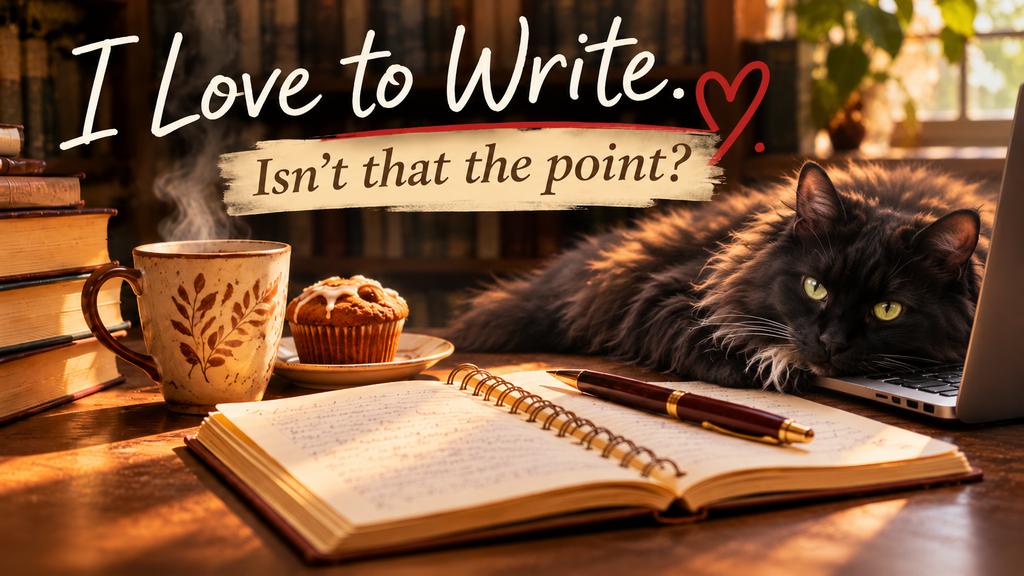
Today, November 15, is I Love to Write Day.
Which seems like an excellent opportunity to talk about something that has been strangely absent from the endless arguments about artificial intelligence and writing. The fact that some of us actually love to write.
I know. Radical concept.
We’ve spent the last few years debating whether AI can write novels, whether it should write novels, whether readers can tell the difference, whether publishers should accept AI-written books, whether using AI is cheating, and whether human authors are about to become obsolete. There’s an enormous amount of noise surrounding the business of writing these days.
Somewhere in the middle of all that noise, we’ve rather lost sight of why so many of us started writing in the first place: Because we love it.
There Are Easier Ways to Make a Living
Let’s be clear about something. Writing fiction is a ridiculous career choice. The pay is frequently terrible. Sometimes it’s nonexistent. Even when you’re reasonably successful, income can swing wildly from one month to the next. There are no guarantees. You can work harder than anyone you know, produce excellent books, do everything the experts recommend, and still fail to find an audience.
Talent doesn’t guarantee success. Neither does persistence. Neither does producing a book that would make Shakespeare weep with envy. (Although I would argue that Shakespeare’s real genius was storytelling, rather than the words themselves. But that’s an argument for another day.)
The publishing industry is a bewildering obstacle course of gatekeepers, algorithms, shifting markets, disappearing opportunities, and rules that seem to change whenever you’ve finally figured out how to follow them.
And then there are the scammers. Oh, the scammers.
If there’s a way to separate an aspiring author from their money, somebody has invented a business model around it. Vanity publishers, fake agents, fraudulent marketing services, bogus book awards, dubious promotional schemes, and now people using AI detection as an excuse to threaten authors. There’s so many schemes and swindles out there, you would think writers were sitting on enormous piles of cash, just waiting for someone to help them spend it.
Most of us are trying to work out whether we can afford another cup of coffee.
And rejection? Putting up with rejection is practically a job requirement. Traditional publishers reject manuscripts. Agents reject queries. Readers reject books. Reviewers reject your carefully constructed story because they don’t like the protagonist’s name, or the ending, or the fact that your science fiction contains science.
Sometimes the rejection is perfectly reasonable. Sometimes it is spectacularly unfair. You learn to live with it.
You also learn that writing the best book you possibly can doesn’t mean the world will notice.
So why on earth do we keep doing it?
Because We Love Writing
That’s it. That’s the great secret. We love making things up. We love finding out what happens next, even when we’re the ones who are supposed to know.
We love the moment when a character suddenly makes sense, when a difficult scene comes together, when something we’ve been wrestling with for days finally clicks into place.
We love building worlds, devising plots, inventing people, and putting them into situations that would make any sensible human being run screaming in the opposite direction.
We love finding exactly the right word.
We love taking something that exists only inside our heads and making it real enough that somebody else can experience it.
Not every minute is glorious, of course. Some days writing is like extracting teeth with a teaspoon. Some scenes refuse to cooperate. Some characters develop the literary equivalent of a sit-down strike. Sometimes the words are horrible and have to be thrown away. And there are days when the blank page looks like an accusation.
But even then, there’s something compelling about the work itself. The process matters. For many writers, it’s the reason we do this at all.
I have days when I reach a flow state and the real world evaporates. I’m living and breathing the story. I can write for hours on days when this happens. As I get older and more practiced at writing, I reach flow state more easily and the fictive dream occurs more frequently. I love those days. When I finally break for a moment, it feels a lot like waking up. I have to orient myself, and blink and stretch.
Frequently, I will discover that hours have gone by, while it feels like only a few minutes to me.
And the story world often won’t let me go. I want to slip back into the dream and keep living through it a bit more.
If I have other, serious commitments for the day, I have to force myself to them. Or else I would spend all day writing the story.
I love writing.
So Why Would I Want AI to Do It for Me?
This is the question I keep coming back to whenever the conversation turns to AI-generated fiction. If writing is the thing I love doing, why would I hand it over to a machine? I understand why some people might want to generate stories without writing them. Perhaps they have ideas they want to see turned into fiction but don’t enjoy the actual process of writing. Perhaps they’re interested in storytelling as a finished product rather than a creative activity.
Fair enough.
But that’s not me. I don’t want AI to write my books for me. I’ve said this before, and I’ll probably be saying it until somebody finally invents the robot housekeeper I’ve been promised since childhood. I want AI to wash my dishes. I want it to do my laundry, fold everything neatly, and put it away in the correct drawers. I want it to clean the bathroom, keep the house tidy, bring me fresh coffee on demand, and occasionally appear with a plate of warm cinnamon muffins.
Preferably without asking me seventeen clarifying questions about how I like my coffee.
I wrote about this recently on my Cameron Cooper science fiction site: AI Can Write a Novel. Why Can’t It Fold My Laundry? It’s a genuine complaint. We seem to have developed technology that can automate the activities humans love before we’ve managed to automate the chores that keep us from doing them. I’d happily hand over the housework. I’d happily hand over a great deal of the administrative drudgery that comes with being an independent author, too. AI can do all that for me.
I’ll just write.
That’s the part I want to keep.
The Point Isn’t Just to Have Written a Book
I wonder sometimes whether we’ve become so obsessed with productivity, efficiency, and output that we’ve forgotten there’s a difference between writing a book and having a book. Publishing is a business. I know that better than most. I’ve been making my living from words for a very long time. There are commercial realities. Readers need books. Authors need income. Publishing schedules exist, and deadlines don’t care whether your muse has wandered off to the Bahamas.
I’m not suggesting we should abandon the business side of writing and float about in a permanent state of artistic bliss. But a book isn’t merely a product that needs to be manufactured as efficiently as possible.
Not to the person who loves writing it.
The hours spent thinking about a story, puzzling through its complications, figuring out what a character really wants, and finding the most effective way to tell it aren’t unfortunate obstacles between the author and the finished book. They’re the experience. They’re what we signed up for.
If I could push a button and have a finished novel appear on my desk tomorrow morning, I might have another book to sell, but I would have missed writing it, and that would be an enormous loss.
In the End, There’s the Page
There’s something else that’s easy to overlook in all these discussions. For all the business machinery surrounding publishing, all the marketing and promotion and algorithms and retail platforms, storytelling remains a remarkably intimate exchange.
An author creates something.
A reader encounters it.
Two people who may never meet, who may live on opposite sides of the world or even in different centuries, share an experience that exists entirely through words.
The reader brings their own imagination, experiences, and emotions to the story. They make it theirs. The author will probably never know exactly what happened on the other side of that exchange. And that’s fine. That’s part of the magic.
I’ve been writing fiction for decades. I’ve published more books than I once imagined I could write. I’ve seen the industry change beyond recognition, more than once. I’ve dealt with rejection, disappointment, impossible workloads, and all the ordinary frustrations of trying to make a living doing something creative. There have been plenty of reasons to stop. But the reason to continue has never really changed.
I love writing. I love telling stories.
I love knowing there’s a reader somewhere on the other side of the page.
And I hope I get to keep doing it for a very long time.
Happy I Love to Write Day.
For pre-order:
<watch this space!>
Latest releases:
Scandalous Sirens Omnibus
Camlann
Even More Time Kissed Moments