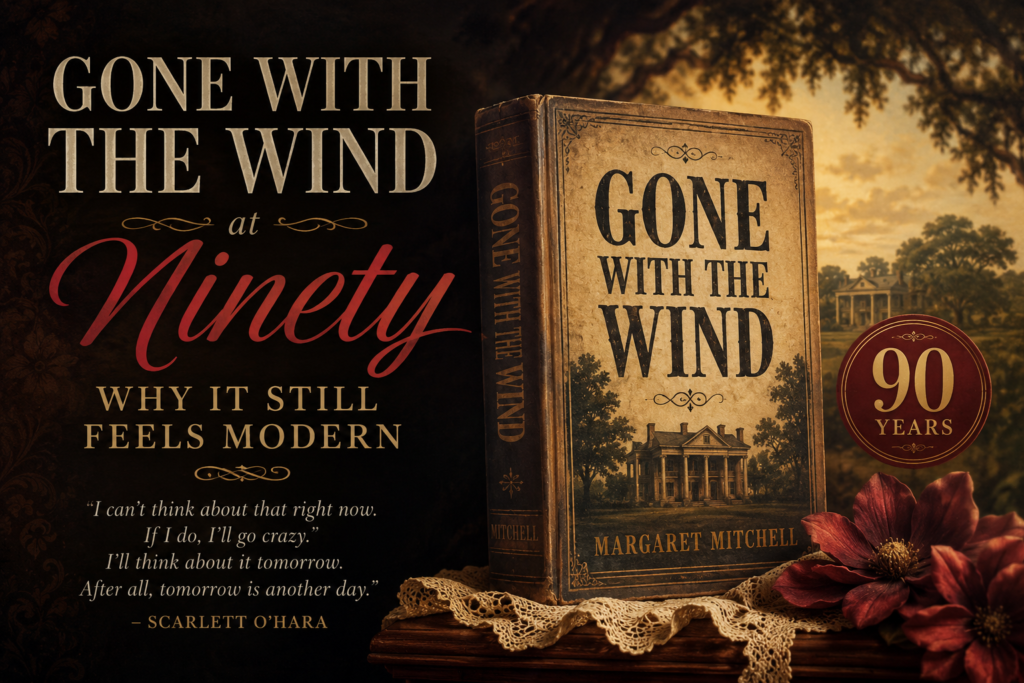
Tomorrow, Gone With the Wind turns ninety years old.
Ninety.
That’s an astonishing lifespan for a novel. Every year, tens of thousands of new books are published. Actually, in this decade, millions of novels are published each year. Even successful novels tend to drift quietly out of print within a decade or two. Yet ninety years after its publication, readers are still discovering Scarlett O’Hara.
Why?
My first encounter with Gone With the Wind wasn’t the famous film. It was the book.
That probably won’t surprise anyone who knows me. I grew up in Australia without television and far away from the nearest cinema. Books were my entertainment, my escape, my education and my passport to everywhere else. I borrowed Gone With the Wind from my high school library simply because it was there, and because a thick novel promised many happy hours of reading.
I didn’t see the film until years later, when VCRs became popular and Gone With the Wind finally appeared on VHS.
Perhaps that’s why, for me, the film has always felt like an adaptation of a story I already knew intimately. I enjoy it enormously—those costumes alone are worth watching—but the novel has always been the real experience.
Margaret Mitchell’s debut novel became an overnight publishing phenomenon when it was released on June 30, 1936. It sold in extraordinary numbers from the outset and won the Pulitzer Prize for Fiction the following year.
Yet I don’t think those are the reasons we’re still reading it. I think we’re still reading it because it doesn’t feel ninety years old.
Many novels of the period still carried the habits of Victorian fiction. Authors wandered from one character’s viewpoint to another, paused to explain motivations, summarized scenes instead of letting them unfold, and occasionally interrupted the narrative to tell readers what they should think.
Mitchell does remarkably little of that. Instead, she stays astonishingly close to Scarlett’s point of view. Everything is filtered through Scarlett’s thoughts, assumptions and feelings.
As a modern novelist, I find that fascinating. The novel feels contemporary because Mitchell trusted the reader.
Scarlett may well be one of literature’s great unreliable observers. Not because she lies. Because she doesn’t understand.
She faithfully reports everything she sees, yet constantly misinterprets the people around her. She idealizes Ashley into someone he can never be. She cannot recognize Melanie’s quiet strength because it doesn’t fit her understanding of the world. And she spends most of the novel completely misunderstanding Rhett Butler.
The reader, however, can see what Scarlett cannot.
Mitchell never stops to explain that Scarlett is wrong. She allows us to discover it for ourselves. The gap between Scarlett’s understanding and reality becomes one of the great pleasures of reading the novel.
It’s an extraordinarily sophisticated piece of storytelling, and one that still feels fresh today.
Then there’s Scarlett herself.
She’s often described as selfish. She certainly is. She’s manipulative, stubborn, frequently blind to other people’s feelings, and capable of making some spectacularly bad decisions.
Yet none of those qualities are what pull me through a thousand-page novel. It’s her relentless determination to survive. Scarlett simply refuses to surrender.
When war strips everything away from her, she doesn’t quietly accept defeat. She refuses to starve. She refuses to lose Tara. She refuses to accept that respectable ladies don’t work.
She gets dirt under her fingernails. She starts businesses. She scandalizes polite society. She breaks every rule that stands between her and survival.
And in the process, she drags dozens of other people along with her. Whether they appreciate it or not, Scarlett simply decides that they are going to survive, too.
Some of her choices are morally questionable. Some are downright appalling. But they are always her choices. She has agency.
That struck me as I reflected on Gone With the Wind. Scarlett feels more modern than the heroines of some bestselling novels published fifty years later. There was a period when many heroines simply endured whatever the plot threw at them. Scarlett never waits for someone else to solve her problems. She solves them herself.
Sometimes brilliantly. Sometimes disastrously. But she is never passive.
Readers will forgive a protagonist almost anything except passivity.
It contains one of the great love stories in literature, but it isn’t a romance in the modern genre sense. The central story is Scarlett’s struggle to survive the collapse of her world. The relationship with Rhett Butler is woven through that story, enriching it and, ultimately, breaking our hearts, but it isn’t the novel’s central plot.
In fact, I think that’s why the ending remains so devastating. This isn’t the story of two people gradually learning to understand each other. It’s almost the opposite.
Scarlett spends most of the novel failing to see the man standing right in front of her. By the time she finally understands what Rhett has meant to her, he is simply too tired to continue.
That’s tragedy. Not romance.
Perhaps that’s why Gone With the Wind continues to inspire such passionate discussion ninety years after it was published. Readers still argue about Scarlett. About Rhett. About Ashley. About Melanie. About the South that Mitchell portrayed and the historical realities she ignored or romanticized.
The novel hasn’t escaped criticism, nor should it. We read it differently today than readers did in 1936, and that’s as it should be. But beneath all the history, the controversy and the unforgettable dialogue is a story that every generation understands.
One woman loses everything. Then decides that she will survive.
That determination is timeless.
Which is why, after thinking about Gone With the Wind for its ninetieth birthday, I find myself wanting to pull my well-worn copy off the shelf and read it all over again. I suspect I’ll discover something new this time, too. After all, that’s another hallmark of a great novel: it changes because we do.
For pre-order:
<watch this space!>
Latest releases:
Scandalous Sirens Omnibus
Camlann
Even More Time Kissed Moments
I have always loved “Gone With The Wind” I have at least 2 copies, hardback and paperback, along with the VHS tape and the DVD copy. I have read it several times over the years after find it when I was in my teens, I’m 68 now and it is a book I consider a classic of all time, along with “Wurthering Heights”. Can’t go wrong with either novel. Thank you for your post email. I had no idea “Gone With The Wind” was 90 years old. Here’s hoping it will be around for another 90 years!! Thank you, Tracy. I know now which novel to read next. “Gone With The Wind”!!
Enjoy the read, Valerie!
I, too, reloaded GWTW onto my ereader after writing this post. 🙂
Tracy