Another in my posts about aerial photos I’ve collected over the years and never got around to using.
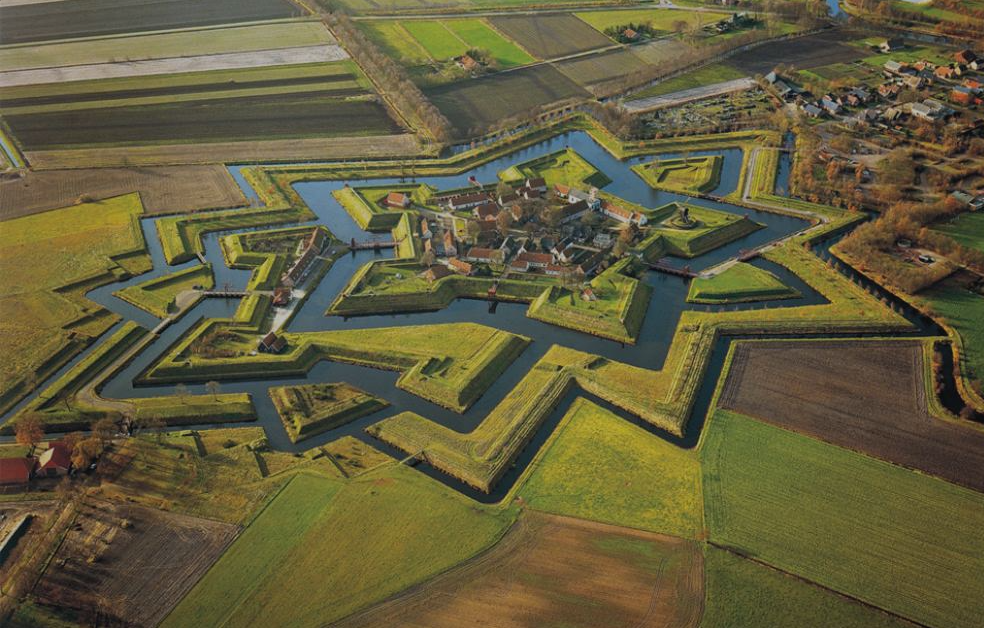
Most people look at a photograph like this one, above, and think, How pretty. I look at it and think, Why?
At first glance, Fort Bourtange looks almost whimsical. A giant star traced across the Dutch countryside, complete with neat waterways, grassy embankments and a tidy little village tucked into the middle.
It’s beautiful.
But then you remember that every ditch, every wall, every angle and every canal was built for one purpose: Defence. And suddenly the question changes.
Why did anyone think a project on this scale was necessary?
An Entire Landscape Built for War
Fort Bourtange was built in 1593 during the Eighty Years’ War, the long struggle that eventually led to Dutch independence from Spain. Its purpose wasn’t to defend a capital city. It wasn’t built to guard a royal palace.
It was built to control a road.
That sounds almost absurd to modern ears. An entire fortress, painstakingly designed and constructed, simply to dominate a route between Germany and Groningen. Yet that road mattered enough that thousands upon thousands of cubic metres of earth were dug, moved and shaped by hand.
No bulldozers. No excavators. No hydraulic equipment. Just people with shovels, carts, animals, and determination.
When I look at this image, that’s what captures my imagination. Not the geometry, although it is astonishing. Not the engineering, although it is brilliant.
I think about the sheer amount of labour involved.
Someone had to approve the expense. Someone had to design it. Someone had to organize workers, source materials, manage construction and keep the project moving.
And then there were the labourers themselves.
History tends to compress achievements like this into a single sentence: “The fortress was built in 1593.” As though it simply appeared.
What Sort of World Was This?
The existence of Bourtange tells us something important about the period.
The Eighty Years’ War wasn’t an abstract political disagreement. It was a conflict erious enough that controlling transportation routes could change the course of military campaigns.
Trade moved along those roads. Supplies moved along those roads. Armies moved along those roads. Control the road, and you controlled far more than a strip of dirt crossing the countryside.
Looking at Bourtange, I can almost see the anxieties of the people who commissioned it. They expected attack. They expected sieges. They expected artillery.
The star-shaped design wasn’t decorative. Those sharp angles eliminated blind spots and allowed defenders to fire upon attackers from multiple directions. Every point, every ditch and every embankment served a purpose.
The entire landscape was shaped around the possibility of violence. That’s a sobering thought.
Could You Live There?
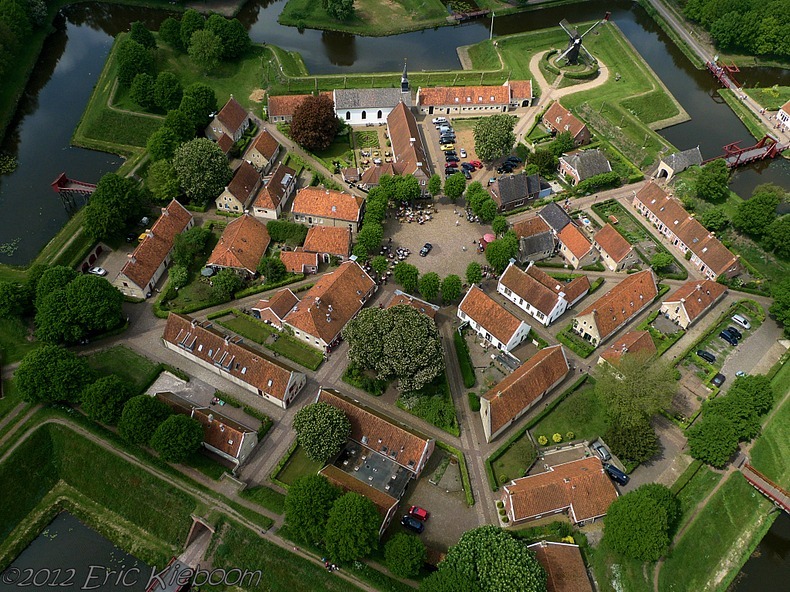
Then my mind wanders in another direction. What would it have been like to actually live there? The closer photographs reveal that Bourtange wasn’t merely a military installation. It was a village.
People raised children there. People married there. They baked bread, mended roofs, argued with neighbours, worried about money and complained about the weather. Life went on, all while surrounded by moats, defensive walls and controlled entrances.
Part of me thinks it would have felt wonderfully secure. Another part of me wonders if it felt claustrophobic. The walls that kept danger out also kept you in. Security always comes with a price.
Perhaps the residents stopped noticing the defences after a while, the same way we stop noticing the things that shape our own lives. The fortress became simply home.
History Shapes Everyday Life
Looking at Bourtange reminds me that political, cultural and economic realities shape daily life far more than we often realize. The people who lived there adapted themselves to the world around them. Their homes, opportunities and routines were determined by circumstances larger than themselves.
We’re no different. When I was a young adult, I could afford to rent a flat on my own. These days, many young adults can’t. Sharing accommodation or moving back home isn’t necessarily a lifestyle choice. For many, it’s an economic necessity.
The forces are different. The principle is the same. People build their lives around the conditions they inherit. Sometimes those conditions produce star forts. Sometimes they produce multigenerational households.
Both are responses to realities larger than any one individual.
A Writer’s Dream Setting
And, naturally, the novelist in me can’t stop there. A place like Bourtange feels ready-made for fiction. I could easily imagine it in a fantasy novel. A fortified settlement surrounded by water, isolated from the wider world, guarding a strategic crossing that everyone wants to control.
Or perhaps a historical romance, where everyone knows everyone else’s business because there are only a handful of streets within the walls. Privacy would be difficult. Secrets would be precious.
The setting itself would generate conflict. Places like this remind me that setting isn’t merely scenery. The shape of a place tells you what its inhabitants feared, what they valued and how they lived.
Which brings me back to my original reaction to the photograph. Not how pretty. But why?
And once I start asking that question, I can lose an entire afternoon following the answers.

Now available for preorder:
Camlann
Latest releases:
Even More Time Kissed Moments
Before, After, Always
Kiss Across Time Box Three