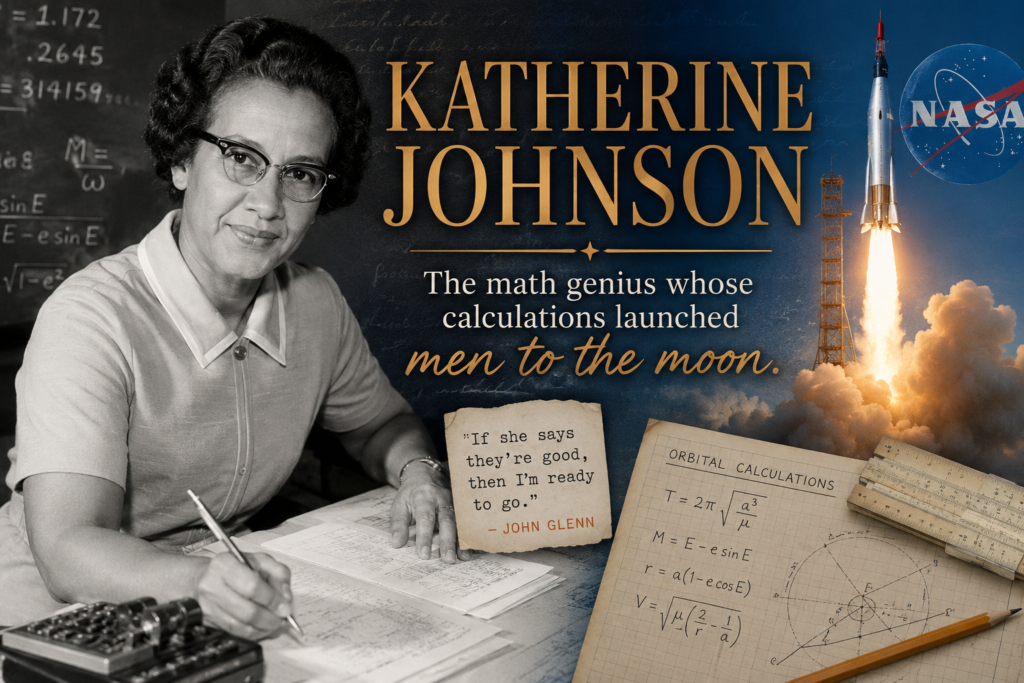
There are some historical figures who vanish so completely into the background of history that uncovering them feels like archaeology. And then there are figures like Katherine Johnson, who were never truly hidden at all. They were standing in plain sight while everyone else looked the other way.
When Hidden Figures was released in 2016, millions of people discovered Katherine Johnson for the first time. Audiences watched her calculate launch windows by hand, fight segregation at NASA, and quietly become indispensable to America’s space program. The movie was emotional, triumphant, infuriating and deeply satisfying all at once.
But it also left many viewers with the same question: Was that really how it happened? Or was Hollywood polishing history into something more digestible?
The answer is both simpler and more complicated than you might think.
The Movie Was True…And Also Not True Enough
One of the striking things about Hidden Figures is that many of the events people assume were exaggerated for dramatic effect were actually toned down. The segregation was real. The dismissiveness was real. The exhaustion of constantly proving herself was real.
Katherine Johnson worked at NASA during an era when Black women mathematicians were literally classified as “computers.” They performed the calculations engineers and astronauts depended upon before electronic computers became reliable enough to trust.
And yes, the segregated washrooms existed.
That infamous scene where Katherine has to walk across the campus to use the “colored” bathroom was based in reality, although the details were compressed and dramatized for the film. Johnson herself later said she often ignored the segregation rules whenever possible and simply used the nearest washroom because she was too busy working to care about the signs. Which, somehow, makes the reality even sharper.
Imagine being so relentlessly competent that you decide segregation itself is too inefficient to obey.
What the movie simplified was the sheer endurance required. In film form, discrimination arrives in scenes. In reality, it was ambient. Constant. Embedded into every meeting, every assumption, every introduction, every surprised look when she spoke up. The movie gives us moments of confrontation because movies need scenes. Real life was death by paper cuts.
She Was Doing Advanced Math Before NASA Knew What To Do With Her
One thing Hidden Figures only briefly touches upon is just how intellectually terrifying Katherine Johnson actually was. This was not simply a “good at math” woman. This was a child prodigy.
She entered high school at ten. Graduated college at eighteen. Taught mathematics before eventually joining the National Advisory Committee for Aeronautics (NACA), which later became NASA.
And once she arrived there, she started asking questions nobody expected women—particularly Black women—to ask. Johnson insisted on attending high-level briefings usually reserved for male engineers. When told women didn’t attend those meetings, she reportedly asked: “Is there a law against it?”
There wasn’t. So she went. That tiny moment says more about her than almost anything else. Not fiery speeches. Not rebellion. Not cinematic defiance.
Just the calm refusal to accept arbitrary nonsense.
John Glenn Trusted Her More Than The Computers
The film correctly portrays one of the most famous moments of Johnson’s career. Before astronaut John Glenn launched aboard Friendship 7 in 1962, NASA had begun relying on electronic computers for orbital calculations. But Glenn didn’t fully trust them yet.
So he requested that Katherine Johnson personally verify the numbers. “If she says they’re good,” he said, “then I’m ready to go.”
Think about that for a second. At the height of the Space Race, during one of the most politically important missions in American history, the astronaut trusted a Black woman mathematician more than the machines NASA was trying to build the future upon.
That wasn’t symbolic. That was survival.
Hidden Figures Wasn’t Really About Space
The movie is remembered as a NASA film, but underneath the rockets and equations it’s really about something else entirely: Who gets allowed into the room where history is made.
That’s why the bathroom scenes hit so hard. Not because of the walking distance. Because of the indifference. The soul-killing normality of it.
The supervisor asking questions without ever once considering why she vanishes for forty minutes at a time. The assumption that the system itself does not need examining. That part feels painfully authentic because bureaucracy has always had a remarkable talent for disguising cruelty as procedure.
The movie also softened some realities by combining characters and simplifying institutional structures. Kevin Costner’s supervisor character, for example, was largely fictionalized; a composite character designed to streamline the story. The dramatic destruction of the “Colored Ladies Room” sign likely never happened in that exact way. Real progress is usually less cinematic. More exhausting. More incremental.
And often achieved by people quietly refusing to move backward.
The Real Story Might Be More Powerful Than The Movie
Hollywood naturally shaped the story into a triumphant narrative. The audience leaves inspired, which is fair enough because Katherine Johnson’s life was inspiring. But the real story contains something even more impressive than cinematic heroism. Persistence.
Not the glamorous kind. The grinding kind. The sort where you keep showing up, keep solving impossible problems, keep forcing people to acknowledge your competence until eventually history has no choice but to write your name down.
Johnson spent decades doing work most Americans never knew existed. By the time the public finally learned her name, she was already in her nineties. That’s astonishing. America put men on the moon before it properly thanked one of the women who helped get them there.
Why Katherine Johnson Still Matters
It’s tempting to look at Hidden Figures as a story about the past. Segregation. 1960s America. Old-fashioned sexism. Problems solved long ago.
Except that stories like Katherine Johnson’s keep resurfacing in every field where invisible labor exists. The people doing foundational work are often the least recognized, the least promoted, and the easiest to overlook until someone finally asks: Wait. Who actually made this possible?
That’s why Katherine Johnson resonates so deeply now. Not because she was hidden. Because history keeps producing hidden figures. And because somewhere, right now, there’s probably another woman doing essential work while someone else gets photographed beside the rocket.
For pre-order:
<watch this space!>
Latest releases:
Scandalous Sirens Omnibus
Camlann
Even More Time Kissed Moments
Yes! Everyone deserves to be seen and appreciated. Everyone!
Yep. 🙂
Tracy
This is yet again another brilliant post about a woman who isn’t spoken about a lot. My favorite line:
“That’s why the bathroom scenes hit so hard. Not because of the walking distance. Because of the indifference. The soul-killing normality of it.”
And image, reading the news today, and watching certain people slowly attempting to change certain laws to go backwards. The sheer cowardess of these people to do whatever they can to stay in power and be ineffective. im sorry about the political stuff, and I know youre Canadian, but it just seemed apropos to compare at this time. Your analysis is spot on and I so look forward to these posts! I wonder if one day we will see a non-fiction book from you?
A book! That’s an interesting idea. 🙂
It’s a sad fact that there are probably enough woman who have been forgotten by history to make an entire book, too. The list I have for these posts is quite long.
Cheers,
Tracy