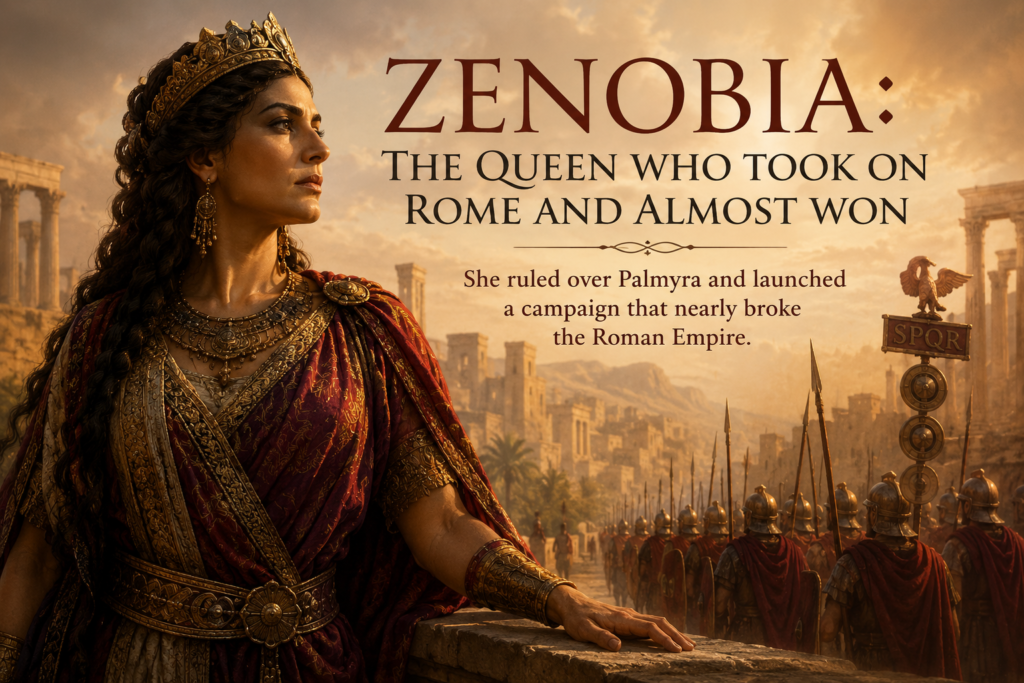
History remembers Cleopatra.
It should remember Zenobia.
Ask someone to name a powerful woman from the ancient world and Cleopatra’s name usually appears within seconds. Perhaps Boudicca. Maybe even Eleanor of Aquitaine if they’re feeling ambitious.
But mention Zenobia and you’re likely to be met with a blank stare. Which is a shame, because Zenobia accomplished something very few rulers ever managed. She looked at the Roman Empire and decided she could do better. And for a while, she was right.
A Queen in the Wrong Century
Zenobia ruled the wealthy desert city of Palmyra, located in modern Syria. Today, it is remembered mostly for its spectacular ruins. In the third century, however, Palmyra was one of the richest cities in the Roman world. Caravan routes carrying silk, spices, precious stones, and luxury goods crossed the desert through Palmyra on their way between East and West.
The city sat at the intersection of cultures. Greek, Roman, Persian, Arab, and Syrian influences mingled there. Wealth poured through its gates.
Then history handed Zenobia an opportunity. The Roman Empire was in trouble. Not ordinary trouble. Civilization-threatening trouble.
Historians call the period the Crisis of the Third Century, which sounds rather neat and academic until you discover what it actually involved. Emperors were assassinated with alarming frequency. Generals declared themselves rulers. Foreign invasions struck the borders. The economy staggered under inflation and instability. Entire regions broke away from central authority.
The Roman Empire wasn’t merely weakening. It was coming apart.
The Widow Who Was Supposed to Behave
Zenobia’s husband, Odaenathus, ruled Palmyra as a loyal ally of Rome. When he was assassinated around 267 CE, power passed to their young son. Zenobia became regent.
At least, that was the official story.
A regent is supposed to preserve power until the child comes of age, but Zenobia had larger ambitions. She quickly emerged as the real power behind the throne and began expanding Palmyra’s influence far beyond its traditional borders.
At first, she was careful. She maintained the appearance of loyalty to Rome. Official declarations remained respectful. Roman authority was acknowledged. Meanwhile, her armies kept moving.
Building an Empire
Within a remarkably short period, Zenobia’s forces seized control of Egypt, Arabia, and large portions of Asia Minor. This wasn’t a local rebellion. This was empire-building. Egypt alone was a staggering prize. It was one of the richest provinces in the Roman world and supplied enormous quantities of grain. Losing Egypt was not merely embarrassing for Rome. It was dangerous.
Yet Rome struggled to respond because Rome had problems everywhere.
Zenobia understood something many leaders fail to grasp. Timing matters. A bold move at the wrong moment is reckless. A bold move at the right moment can change history.
The Ancient Art of Personal Branding
One of the most intriguing aspects of Zenobia’s career is how carefully she managed her image. She reportedly claimed descent from Cleopatra. Whether the claim was true remains uncertain, but the brilliance of the claim is that it didn’t need to be true. Everyone knew who Cleopatra was. By linking herself to Egypt’s most famous queen, Zenobia borrowed prestige, legitimacy, and historical weight. She transformed herself from the ruler of a desert city into the heir of a legendary dynasty.
She also tailored her image to her audience. To Romans, she was a loyal ally maintaining stability. To Egyptians, she was a successor to the ancient pharaohs. To local populations throughout the East, she was a strong regional ruler defending their interests.
Modern politicians hire consultants to teach these skills. Zenobia understood them instinctively.
The Moment History Could Have Changed
One of the great mistakes we make when looking backward is assuming events were inevitable. They weren’t. There was a moment when Zenobia’s empire controlled enormous territories, vast wealth, critical trade routes, and some of the most important cities in the eastern Mediterranean. There was a moment when a permanent eastern empire seemed entirely possible.
Imagine a world where Rome never reunified. Imagine a Roman West and a Palmyrene East developing side by side for centuries.
It almost happened. Almost.
The Emperor Who Ruined Everything
Unfortunately for Zenobia, Rome eventually produced exactly the leader it needed. Emperor Aurelian was competent, determined, and relentless. He systematically reconquered lost territories and marched east against Palmyra. Zenobia’s armies were defeated. Palmyra was besieged.
Zenobia attempted to escape and seek aid from Persia, but she was captured before she could get away.
The rebellion collapsed. The empire she had built vanished almost as quickly as it had appeared.
Why Zenobia Matters
History often celebrates those who succeed. Yet some of the most fascinating figures are those who came close enough to reveal how fragile history really is. Zenobia reminds us that Rome’s survival was never guaranteed.
She reminds us that empires can appear permanent right up until the moment they aren’t.
Most of all, she reminds us that intelligence, ambition, timing, and an understanding of human nature can sometimes carry a person astonishingly far.
For a few extraordinary years, a queen from a desert city stood toe-to-toe with the most powerful empire in the world.
And for a little while, the outcome was genuinely uncertain.

For pre-order:
Scandalous Sirens Omnibus
Latest releases:
Camlann
Even More Time Kissed Moments