.
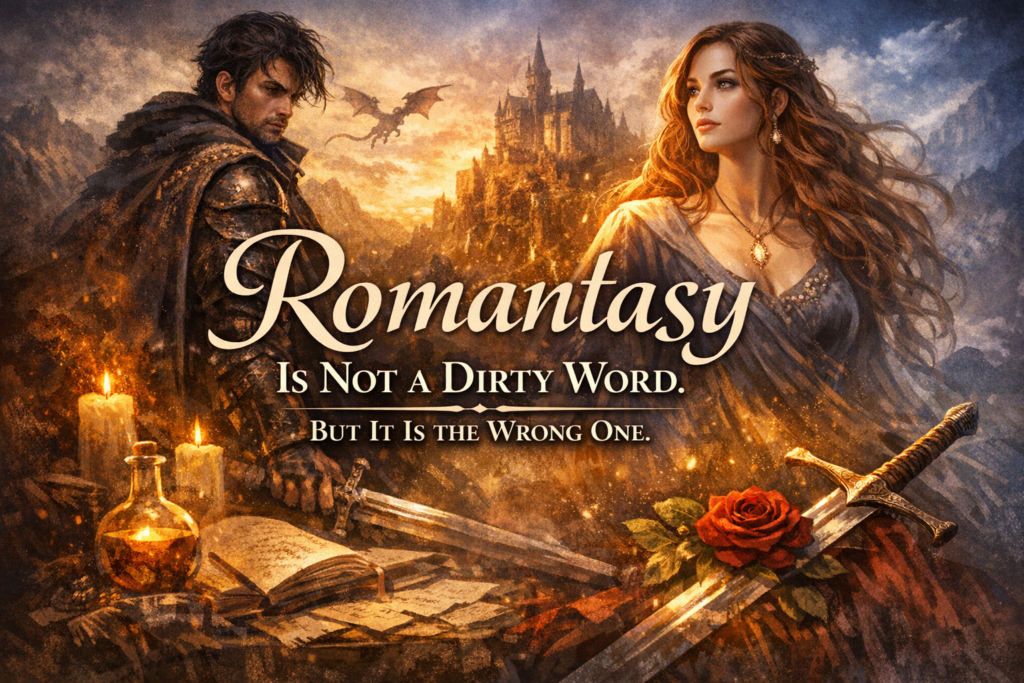
Apparently, I am not alone in loathing the word “romantasy.”
Fantasy author Danielle L. Jensen has been publicly pushing back against the label this week, after yet another round of media and retailers insisting upon applying it to her books whether she likes it or not. She said:
“I find the category ‘romantasy’ unhelpful, and I don’t use it in any of my branding; I am a fantasy author who writes a fair bit of romance in my books.”
And then, with rather more bite:
“They can have one kiss and it becomes romantasy just by virtue of the fact that you have a woman author who is writing it.”
Exactly.
Jensen’s complaint is not that her books contain romance. It is that the label flattens everything else. It suggests that once there is a love story involved, the politics, the worldbuilding, the danger, the wars, the impossible choices and the fantasy itself all become somehow secondary. As though there was kissing, therefore clearly the dragons are optional.
I have been refusing to use the word “romantasy” for years. Stubbornly. Publicly. Repeatedly. Every time someone tries to apply it to my books, I find myself grinding my teeth and muttering that I write fantasy romance. Not romantasy. Fantasy romance.
Apparently this makes me sound like the old woman at the back of the room insisting that we called them records, not vinyls, and everyone should stop putting “artisan” in front of the word “bread.”
But I have reasons.
Because “romantasy” is not just an awkward, clunky label. It is a label that has managed to flatten an entire genre into something silly and dismissible. It suggests that if there is a sword, a dragon, and two people looking moodily at each other from opposite sides of a book cover, then the romance must somehow have infected the fantasy and made it less serious.
As though fantasy and romance are somehow enemies.
As though the presence of love automatically means there can be no worldbuilding, no political intrigue, no difficult choices, no moral complexity, no looming magical catastrophe.
Which is nonsense.
Fantasy romance has always existed. It has always been difficult to write well. And it deserves far more respect than it gets.
The Problem With “Romantasy”
The nickname is meant to sound cute and marketable. It is short. Punchy. Hashtag-friendly. Unfortunately, it also sounds faintly patronizing.
The term creates the impression that fantasy romance is fantasy-lite. That the fantasy is merely decorative. That the dragons, kingdoms, wars and magic systems are there mostly to provide somewhere atmospheric for the kissing to happen.
There absolutely are books where that is true. Every genre has its flimsy versions. There are thrillers with no real suspense. Historical novels where everyone speaks like they are attending a twenty-first century brunch. Science fiction where the science appears to have been borrowed from a cereal box.
Romance is no different.
For a long time, traditional publishing was flooded with what romance readers called wallpaper historicals. Historical romances where the “history” amounted to a few references to corsets, carriage rides and heaving bosoms. The plot could have been transplanted to modern-day Chicago with only a few changes of clothing.
The same thing occasionally happened in fantasy romance. A castle here, a magical artifact there, perhaps a hero with pointy ears, and apparently that was enough.
But readers do not tolerate that anymore. Nor should they.
Writing Fantasy Romance Means Writing Two Genres At Once
This is the part many non-romance readers do not understand. Romance is already difficult to write well.
A convincing love story requires emotional progression, chemistry, tension, conflict, vulnerability, and payoff. The characters have to change because of each other. Their relationship has to matter. The ending must feel earned.
Now add fantasy on top of that.
Now you also need a coherent world, an internally consistent magic system, political and social structures, conflict, danger, pacing, and stakes that extend beyond whether the hero and heroine will finally kiss.
Fantasy romance authors do not get to take shortcuts. We do not simply write a romance and drape a velvet cloak over it. We have to learn how to write fantasy as well as romance.
The best fantasy romance balances both genres perfectly. Remove the romance, and the story no longer works. Remove the fantasy, and the story no longer works. Each part is essential.
That is why fantasy romance belongs in the same family as historical romance, romantic suspense and science fiction romance. The secondary genre is not decoration. It is not wallpaper. It is a full, functioning part of the story.
A science fiction romance writer must understand science fiction.
A historical romance writer must understand history.
A fantasy romance writer must understand fantasy.
And not just the pretty bits.
We have to understand how to build worlds that feel real. We have to understand politics, power, geography, mythology, conflict, magic, religion and consequence. We have to make readers believe in impossible things. While also making them believe two people could fall in love.
Frankly, that is rather a lot to ask of one writer.
Why Fantasy Readers Might Actually Love Fantasy Romance
I suspect many fantasy readers avoid fantasy romance because they think they know what it is. They imagine endless longing glances, perhaps a few strategically unbuttoned shirts, and a plot that wanders vaguely around in the background looking lost.
But genuine fantasy romance is not that. Fantasy romance still has all the things fantasy readers love:
- Dangerous worlds
- Impossible choices
- Moral complexity
- Magic with consequences
- Political intrigue
- Characters forced to risk everything
The romance simply gives all of those things greater emotional weight, because a war matters more when the people fighting it have something personal to lose, and sacrifice hurts more when love is involved. Because impossible choices become even more impossible when your heart is on the line.
The emotional core strengthens the fantasy instead of weakening it.
Some of the most memorable fantasy stories have always contained powerful romantic arcs. Readers have never objected to that when the books were written by male authors and shelved in fantasy. Somehow, however, when a woman writes a story where the relationship is equally important to the quest, the entire book is suddenly shoved into a pink corner and given a nickname.
Curious, that.
The AI Problem
Unfortunately, the rise of the word “romantasy” has coincided with another problem. A flood of quickly-produced, algorithm-friendly books that rely on familiar tropes, fashionable covers and a checklist of ingredients:
- One brooding immortal male.
- One stubborn heroine.
- One magical bond.
- Several scenes involving intense eye contact.
- Possibly a dragon.
The result is often a book that feels assembled rather than written. The fantasy is shallow. The romance is mechanical. The characters are less people than bundles of marketable traits.
AI-written fiction has made this even worse, because AI can imitate the surface of a genre astonishingly well. It can produce all the recognizable signals: the enemies-to-lovers banter, the dark prince, the ancient prophecy, the suspiciously attractive villain.
What it cannot do is understand why those things matter. It cannot create the intricate balance between fantasy and romance that makes the genre work. It cannot understand emotional truth. It cannot build a world with real depth or create a relationship that grows in ways that surprise and move the reader.
And when people encounter these hollow versions of the genre, they assume that is what fantasy romance is. It is not. It is the fast-food version. Convenient, forgettable, and liable to leave a bad taste behind.
I Will Keep Calling It Fantasy Romance
Perhaps this is a losing battle. Perhaps “romantasy” is here to stay. Publishing does love a catchy label. But I will continue to call my books fantasy romance because the term respects both halves of the story.
It acknowledges that the romance matters. It also acknowledges that the fantasy matters just as much.
Fantasy romance is not lesser fantasy. It is not embarrassed fantasy. It is not fantasy with a decorative boyfriend attached. It is a demanding, ambitious genre that asks writers to master two forms at once and asks readers to care deeply about both.
Which, when you think about it, is rather magical.
For pre-order:
<watch this space!>
Latest releases:
Scandalous Sirens Omnibus
Camlann
Even More Time Kissed Moments
“Romantasy.” Ugh. I agree with you wholeheartedly. Fantasy and romance are entirely different genres that require skill and talent – each in its own right.
And combining them makes them more than twice as difficult to execute well. 🙂
Tracy
Did you see AI is corrupting music now as well? You can open up Spotify and find any number of AI generated “bands” or “singers” or even “rappers” on it, gathering market share from listeners that most probably don’t realize that they aren’t real. It’s gross! Where is it going to end? Trump & his conservatives don’t want any boundaries on AI, but it’s already out of control and causing pollution, job losses, higher energy costs and stolen property.
AI is creeping into everything. Even our spell-checkers are AI-based now. It is next to impossible to avoid.
Tracy
I hear you, and there isn’t even a word for someone who writes SF with romance (as I do). SF has always had romances. When I asked Mary Robinette Kowal how I could sell my books, she said (only partly in joke) “be a man”. Because male SF writers almost always have a romance in their books – but as soon as a woman’s name appears on the cover of an SF with romance, there’s an assumption (it seems to me) that it’s not a serious novel.
If, however, I try to market as SF romance, the readers seem to want green skinned multi-appendaged heroes with nothing better to do than the heroine. My romances are between older humans, with closed door sex scenes if any at all (honestly, some of my characters are just plain shy!)
Er … sorry, rant over!
Yes, that’s a genuine genre issue that I struggle with, too. My SFR is like yours, which romance readers don’t appear to be interested in.
My best advice is to find your readers one at a time, and keep them close, until you have a readership that loves your stuff and makes you independent of commercial genre vagaries.
Tracy