This is a post that, like many on this twenty-year-old site, seems to have disappeared into the ether. I’ve updated and expanded on it. – t.
It Started With the Dresses
I was first drawn to historical romances because of two things.
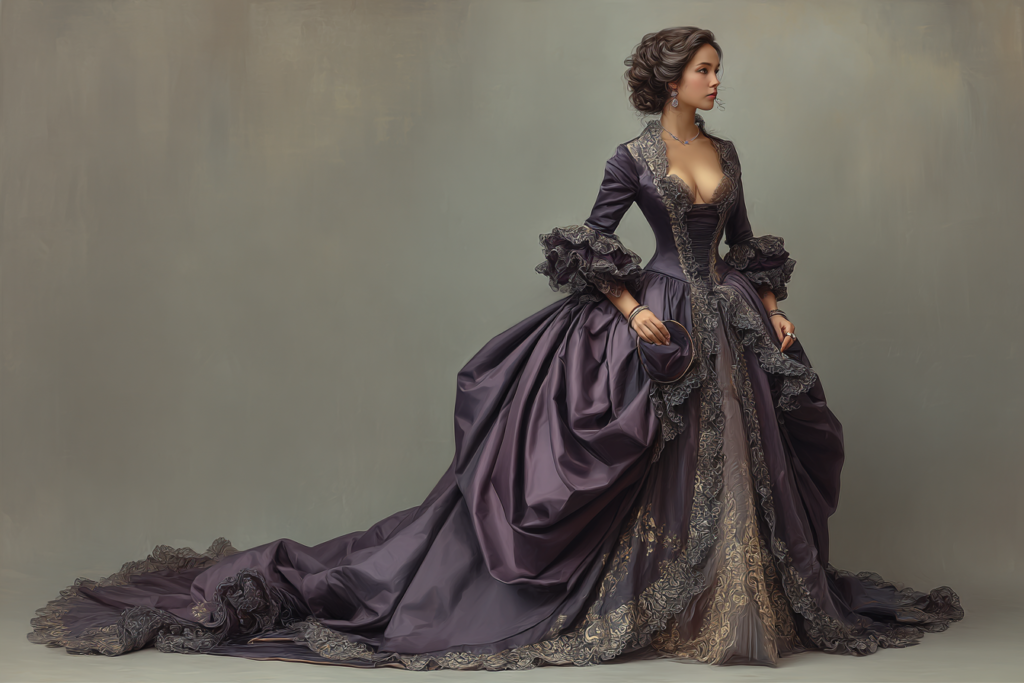
One was, absolutely, the dresses. A woman looks so much more womanly in some of the gowns she gets to swan around in, depending on the period. And with her breasts and waist emphasized the way most of history seems to have made a point of outlining them, you can hardly blame heroes for wanting to slide their hands around a pulled-in waist and peer down at an enticingly corseted, snow-white—and usually heaving—bosom. Low-rider jeans just don’t cut it.
This factor doesn’t always work, of course. My heroine in Diana By The Moon made an art form out of appearing unappealing—but even she had her moments. And those moments simply couldn’t happen in a contemporary story.
Take this one:
“She wore a simple white gown that flowed to the ground and shimmered faintly in the candlelight. Her hair, which he had only ever seen bundled or braided, was loose and curled around her shoulders. A circlet of flowers crowned her head. She looked ethereal. Unreachable. He could not speak. Could not think. Only look.”
No jeans and t-shirts will ever deliver that level of impact. Long white gowns and flower crowns don’t exactly show up on a Tinder date.
Which is why I love it when cover artists get the fashion of the era right. I’ve seen Regencies where the heroine is wearing a crinoline (wrong decade by miles), and Reformation-era covers with bustles (wrong everything). Just because the hem touches the floor doesn’t make it accurate. Historical covers are a whole different blog post, though. 🙂
Descriptions That Let the Imagination Fly
If the author of a historical novel has done their homework, they’ll pause to describe the clothing—and I love these bits. One of my favourite chapters in Gone with the Wind is right at the beginning when Scarlett is obsessing over what to wear to the barbecue. There’s a deep dive into her wardrobe, fabrics, waist size, and Mammy’s corset-lacing skills.
These aren’t just throwaway details. The imagination goes into overdrive when you read them. Modern clothing is about personal expression, but historical clothing came with layers of meaning and implication. One fashion misstep could ruin a woman’s reputation. In Regencies, the wrong neckline could ruin a life.
Here’s a perfect example from Mask of Nobility:
“The gown was heavy. It was also unlike anything she had ever worn. Its rich green fabric shimmered like emeralds under candlelight. The sleeves clung to her arms to the elbow, then flared wide. Silver threads formed vines across the bodice and down the skirts. Her stays pulled her waist in so tightly she could barely breathe, yet her posture was suddenly regal. She felt like someone else entirely. A lady. A stranger. A chess piece.”
That’s not just a dress—it’s transformation, disguise, societal pressure, and power, all stitched into green silk and silver thread. And it’s an experience unique to historical romance. There’s nothing quite like watching a heroine literally step into a role she never thought she’d play, just by putting on a gown.
Courtship with Constraints = Delicious Tension
One of the best things about historical romances is how rules and etiquette build slow-burn romantic tension. A brush of a hand, a stolen glance—those moments mean something. There’s no texting “u up?” in the middle of the night. There’s anticipation. Yearning. Delicious frustration. The tension builds because it has to, and that makes the payoff so much sweeter.
Take this moment from Season of Denial:
The women all rose to their feet, forcing her to her own.
Gascony smiled up at her. “I will join you in the salon later, yes?” he asked.
“Yes, please.” Before she could reconsider the wisdom of it, she rested her hand on Gascony’s shoulder and gave it a small squeeze.
He looked inordinately pleased. His hand groped for hers and squeezed her fingers.
Mairin’s gaze fell on his mouth once more. The swell of feelings never rose when she examined his lips, the way it did when she merely looked at Iefan. Perhaps it would come later. She had not yet kissed Gascony, after all.
With a sigh, she let her hand drop and followed the rest of the ladies down the long dining room to the doors at the end, which led into the drawing room.
Iefan watched her with narrowed eyes, his hand curled around a brandy snifter already three quarters full.
He had turned in his seat, his other arm over the back of the chair, to properly watch her. Mairin’s heart shuddered. How could he be so careless about appearances?
Then she remembered. Iefan cared nothing for appearances.
This isn’t a kiss. It’s barely even a touch. But it’s loaded. Every character in the room reacts to it. Social expectations are stirred. Appearances are threatened. Emotions flare. All from the briefest contact and a look across the room. That’s the beauty of courtship under constraints—it magnifies the meaning of every moment.
Political Intrigue and High-Stakes Drama
The second thing that hooked me was the ability to weave in political or suspense storylines. History is full of juicy conflict that isn’t just “he ghosted me.” Wars that tore families apart. Revolutions that turned nobles into refugees. Women moved like chess pieces across Europe’s courts. Whole villages burned because someone got on the wrong side of the local priest. You simply can’t get those stakes in a modern office romance.
Historical romance gives space to explore moral ambiguity in ways that feel grounded in real human history. Like this moment from Season of Denial, where Mairin confronts Iefan about his past:
“Is it true you got rich smuggling guns into France?” she asked.
“That I got rich smuggling guns? No. I made more money smuggling food. You would be surprised what a hungry man will pay to have his belly filled,” Iefan replied.
“Isn’t that awfully ruthless? Taking money from starving people?”
“They have no need of the money. There is nothing to buy there.”
“And you clearly have no use for morals.”
“Not of the type which would stop me from saving lives,” he said sharply. “The money buys more food, Mairin.”
That’s not a throwaway backstory—it’s the kind of ethical gray zone historical settings make possible. The stakes are real. The choices matter. And the romance, when it blooms amid this kind of complexity, feels earned.
There are stories that can only happen in the past—when women were expected to smile and stitch, and yet managed to burn down empires. And sometimes they did it while wearing silk.
Escaping the Present with the Past
Here’s a newer reason why I cling to historicals: they’re a balm for modern life. Even when the stories are tragic, they’re a step away from now. I don’t have to think about social media algorithms or climate dread while I’m deep in the Napoleonic wars or the court of Henry VIII.
It’s the same reason I also read science fiction and fantasy. When the present is too much, I prefer to run far, far away—either backwards or way forward.
No Tech. No Texts. Just Connection.
Another overlooked delight: no phones. No DMs. No scrolling. Just people talking. In person. With consequences. Characters can’t ghost each other—unless they actually die and haunt the manor. There’s something deeply human about watching relationships evolve without screens mediating every moment.
Playing With Archetypes
Historical romance also lets us play with the old archetypes—the brooding duke, the clever governess, the rake with a secret. They’re comfortable, yes, but far from boring. The historical setting reshapes them. Gives them texture. A modern billionaire alpha male might buy the heroine’s company. A medieval lord might have bought her father. Context matters.
In Touched by Maen Llia, these archetypes take on even more mythic weight—queens, orphans, and druids who speak with stones. But they’re not just symbols. They evolve and press against their roles. Like this moment:
“You were a foundling,” the queen said, as if that explained everything. “You had no name, and you were raised in the forest.”
“The druids gave me a name,” she said steadily. “They taught me to speak, to write. To listen to the stones.”
“The stones.”
“But I am the first to speak for them.”
“So you say,” the queen murmured.
That’s the magic of historical (and historical-adjacent) romance: the archetypes are familiar, but never stale. They’re stories with lineage, but also rebellion.
Language Like Verbal Velvet
Then there’s the writing itself. A well-written historical romance can feel like poetry. The cadence of the dialogue, the formal speech patterns—it’s like verbal velvet. Even the insults are elegant. (“Sir, you mistake impudence for wit.”)
When a story sounds beautiful out loud, it sticks in the heart longer.
Take this moment from Heart of Vengeance, one of my own medievals:
“I would have you go inside,” he said softly, his voice barely carrying across the dark courtyard. “And I would have you sleep warm, and long, and forget this night ever happened. And if you wake in the morning and remember it only as a strange dream, then I will be content.”
That’s not just dialogue—it’s longing, regret, and tenderness all wrapped in a rhythm that reads like a lullaby. You don’t get that in stories where the romantic climax is a text message reading “wyd?”
So Why Would I Ever Stop?
Historical romance might not be the hot genre right now. The market might have cooled. But it’s not dead. Not while there are still readers who swoon at a well-timed bow or a desperate horseback pursuit. Not while there are writers who still obsess over whether the petticoats are accurate.
There’s just too much richness, too many stories, too many beautiful, tragic, daring possibilities in history to give it up.
So I won’t.
Why Do You Love Historical Romance?
I’ve shared my reasons—some nostalgic, some new. I’d love to hear yours. What keeps you reaching for a historical over a contemporary? Let’s talk about it.
Now available for preorder:
Even More Time Kissed Moments
Camlann
Latest releases:
Before, After, Always
Kiss Across Time Box Three
The Grail and Glory
Verbal velvet!! Love that description for the writing style and it’s so true! It’s my one true addiction for historicals, the repartee between characters IS poetry, especially with your strong and developed female often butting heads with their male!
I also like the clothing and have a pretty developed knowledge of styles and eras over the years of reading. The social constraints and morals that decide a reputation were unforgiving of mistakes.
Thank you for keeping historicals in your back pocket to pull out later, I’m hoping that means more adventures of Lady Adelaide of the Adele Becket series.
Hi Ing!
Technically, the Adelaide Becket series is not a romance series, although there is a romance sub-plot in the series, and will be more, in later stories. 🙂
Tracy
I really enjoy almost anything historical. I started as a teenager to read the series ‘Catherine” by Juliette Benzoni and haven’t looked back. I had all the books. No Kindle in the 60s.
Yes I do read several different types, but I seem to always return to the well written historical stories.
I do appreciate the emails you send that include historical blurbs. The time you take to research the information is unbelievable. It’s a wonder you have time to actually write books!
Any recommendations, Carole?
Tracy
I love historicals, but not westerns. I love that it gets you away from your real life, for awhile. And, in the back of my mind, I always wonder, did I live then? Am I reading these stories to see if I can find myself? Whimsical of me.
I think we all project a bit of ourselves into the main character when we’re reading.
That’s why I like historical authors who can make you feel like you are *there* in the story. 🙂
Tracy
Dress was far more elegant back then, although wearing a corset could be tricky. That was a really great article.
I’ve heard that wearing a corset was actually extremely comfortable. Yes, you could not bend in the middle, but you were well supported everywhere. Society had trouble getting women to *stop* wearing their corsets in the 1920s. They didn’t want to give them up.
Tracy
My grandmother taught me to read before I started school back in 1970 something. She was a lover of books, mostly history. The first book I was gifted was a true collection of Grimms Fairy Tales, not the sweet/innocent Disney versions, I was 3. My grandmother and I would watch old period movies, plays, musicals, and ballets. She introduced me to good literature, not twaddle, it stuck. I quickly fell in love with reading Agatha Christi, Victoria Holt, and Mary Stewart, reading every title in the school library. I also love research, so I would (and still do) look up things that I read about, often times falling into the rabbit hole. Why you ask, because history is my hobby I guess, just like it had been for my grandmother. I have taken it a few steps further, I’ve recently joined a “Pirate Krewe” and now I’m dressing up monthly, or more, and hanging out with a bunch of other people who either don’t want to group up, or just need a magical re-prieve from the world.
Your grandmother sounds like a treasure! What a great childhood!
I think a love of history is planted early, and usually via stories. I know that was the case for me.
Cheers,
Tracy