Mark and I have just finished watching The Americans. Yes, it’s a bit older, but we like to binge watch, and therefore wait for everything to drop. And we kept hearing about how it was a brilliant series (it is). And it has a kick-ass heroine. Finishing the series has left me in the mood for more spies. Although, to be fair, I’m usually in the mood for more spies.
Spy novels seem to be an acquired taste. I’ve never had to work particularly hard to acquire it. Give me two people having an entirely ordinary conversation, let me in on what one of them is hiding, and I’ll sit there wondering what the other one knows for a whole chapter.
I’m also doing my annual review of Project Kobra, my romantic espionage thriller series (yes, really), and being reminded how much I love it and how much I want to get back to it and finish it. I’ve slipped some altogether less official spies into my romances, too, including the The Vistaria Affair. Apparently, even when I’m writing about other things, someone will find a reason to listen at a door.
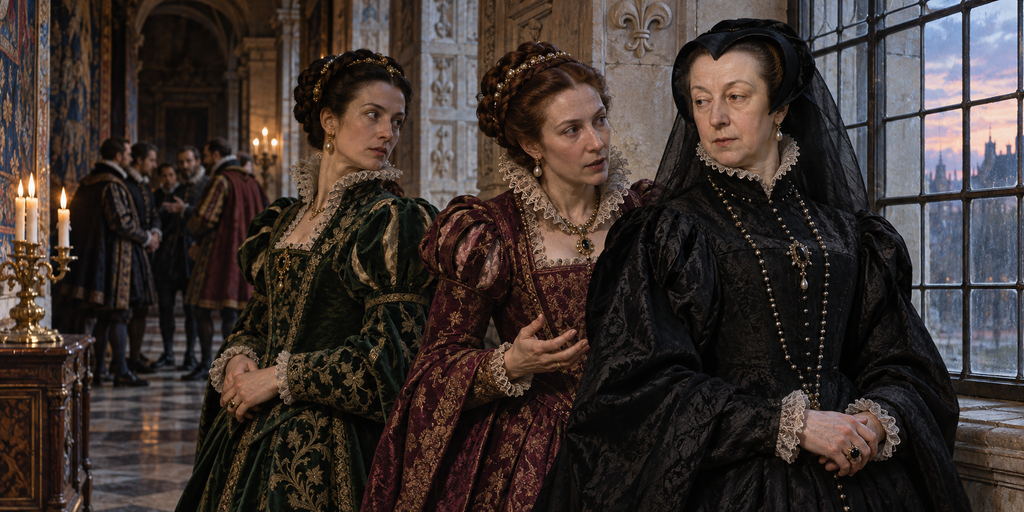
So when I came across the story that Catherine de’ Medici kept a squadron of women at court to seduce men and ferret out their secrets, you can imagine how long it took me to decide what this week’s Her Side of History would be about.
About as long as it took me to get to the word squadron.
The Queen’s Women
Catherine came from the Florentine Medici family, but it was at the French court in the sixteenth century that she became a political force. She married the future Henri II, and three of her sons went on to become kings of France. She spent much of her adult life at the centre of French politics during the Wars of Religion, when a quarrel between relatives could have consequences considerably beyond who sat next to whom at dinner.
The famous version of the story has Catherine deploying her ladies-in-waiting wherever a powerful man had a secret worth knowing or an alliance worth breaking. The women supposedly did their work in bed and brought the results back to the queen. Delicious. I’d watch that series, too.
Then I came across Charlotte de Beaune, better known as Madame de Sauve, and the plot thickened in a way I hadn’t expected.
A Queen, a Wife and a Very Interested Witness
One of our sources for Charlotte is Catherine’s own daughter, Marguerite de Valois. In her memoirs, Marguerite describes how her husband, Henri of Navarre, and her brother, the Duke of Alençon, became rivals for Charlotte’s affections. The two men had been political allies. According to Marguerite, their rivalry over Charlotte was just what someone at court wanted.
And whom does Marguerite credit with the scheme?
A man named Le Guast, a favourite of her brother Henri III. In the story told by the woman whose husband and brother were involved, it’s Le Guast who sees what use he could make of Charlotte. The version that’s come down to us as the “Flying Squadron” puts Catherine in charge of the sort of intrigue her own daughter attributed to somebody else.
I love that wrinkle. Marguerite gives us an account of what happened to people she knew intimately. She also has loyalties, grievances and a version of events she wants us to believe. And I’d dearly love to hear what Charlotte would have made of the whole thing. What did she want? What did those men think she wanted? How much did they get wrong?
You see why I like spy novels.
How a Household Became a Spy Ring
The historian Una McIlvenna traced the “Flying Squadron” legend through the pamphlets, satirical verses and court memoirs that helped give it life. Catherine’s enemies depicted her household as a place of sexual corruption. Over time, later writers took some of that material as a description of how the court actually worked. When McIlvenna looked at the women Catherine appointed, she found experienced and respected members of the French nobility, chosen in keeping with established French court traditions. A standing corps of seductresses taking orders from Catherine belongs to the legend.
The women’s access to power was real, though. They spent time with the queen. They had families and connections of their own. A woman who knew which two people had stopped speaking to each other might understand what was about to happen at court well before the men involved were prepared to admit anything had changed. And if a woman’s influence bothered you, there was a ready explanation for how she’d got it. You could tell everyone she’d slept with somebody.
I went looking for a story about Catherine finding out other people’s secrets. I came away wondering how many people found it useful to have everyone believe she was doing exactly that. Four and a half centuries later, the rumour still did its job on me. Put queen and squadron of female spies in the same sentence and I’ll follow you anywhere.
Which brings me back to The Americans. We finished it, and now there’s a vacancy in my evenings. If you’ve read a spy novel that kept you up because you had to find out who knew what, tell me what it was. I’m particularly keen on one where the women have plans of their own.

For pre-order:
Solstice Turning
Latest releases:
Scandalous Sirens Omnibus
Camlann