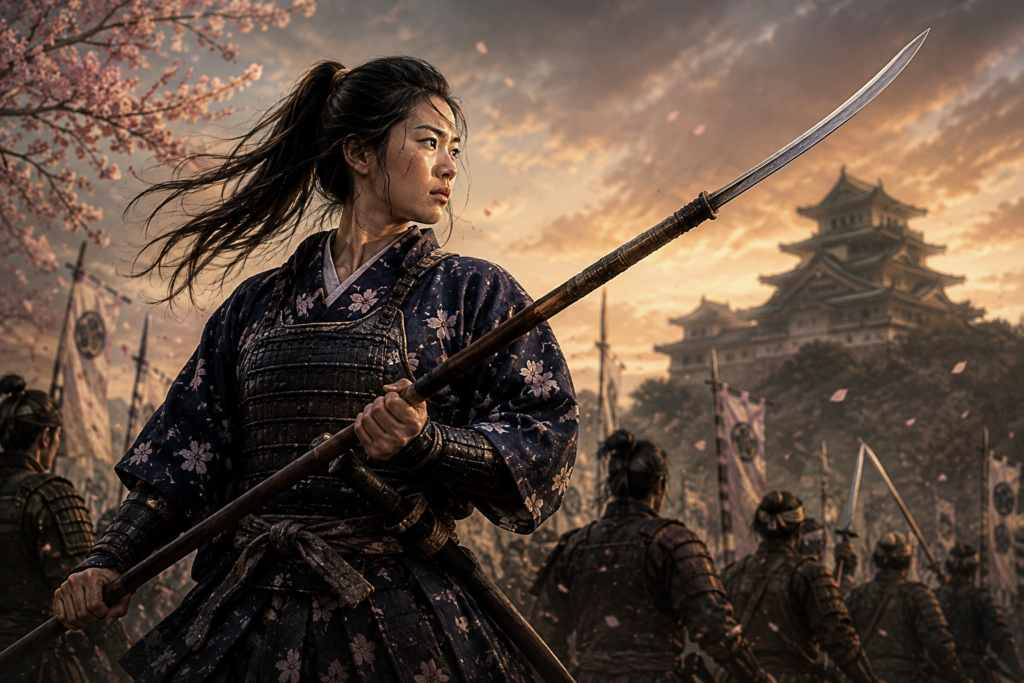
History has a habit of changing its mind. Not because the past changes, but because historians keep asking better questions. They dig up new evidence, challenge old assumptions, and occasionally decide that the words we’ve been using for generations aren’t quite right after all.
Japan’s women warriors are a perfect example. For decades, English-language books usually called them onna-bugeisha. If you’ve watched documentaries, read historical novels, or browsed Wikipedia a few years ago, that’s probably the term you encountered.
Today, historians increasingly prefer onna-musha.
It’s not merely a change in fashion. The two terms carry slightly different meanings. Bugeisha refers to someone trained in martial arts, while musha means a warrior—someone who actually fought. Not every woman trained to use weapons saw battle, but those who are remembered in history earned that distinction the hard way.
One of the last and greatest of these women was Nakano Takeko. Her story unfolds at the very end of the samurai age.
The End of an Era
When most people think of samurai, they imagine medieval Japan: castles, armour, swords, and mounted warriors.
Yet the final great stand of the samurai took place astonishingly late. The Boshin War lasted from 1868 to 1869, while Britain was laying railway lines across the globe, the United States was rebuilding after the Civil War, and photography was becoming commonplace.
Japan stood at a crossroads. For more than 250 years, Japan had been ruled by the Tokugawa shōguns—military rulers who governed in the emperor’s name. The emperor remained the nation’s symbolic sovereign, but real political power rested with the shōgun and the samurai class that supported him.
For more than two centuries the country had been ruled by the Tokugawa shogunate. The emperor existed, but held little real political power. Then the outside world came knocking.
American warships arrived in 1853 and forced Japan to open its ports to foreign trade. The resulting political upheaval split the nation. Those who supported the emperor wanted to modernize Japan rapidly. Those loyal to the shōgun sought to preserve the old samurai order.
Those disagreements erupted into civil war. The imperial forces embraced modern warfare. They purchased rifles and artillery, organized Western-style armies, and adopted new military tactics.
Many samurai still carried swords.
The clash was as much between two eras as between two armies.
A Warrior’s Education
Nakano Takeko was born in 1847 into a samurai family. Unlike most women in many parts of the world during the nineteenth century, daughters of samurai families often received martial training. They learned to defend their households if the men were away at war.
Their preferred weapon was frequently the naginata—a long wooden shaft tipped with a curved blade. Its length helped offset differences in reach and strength, making it an exceptionally effective defensive weapon.
Takeko excelled. She became renowned for her skill with the naginata and eventually taught martial arts herself. No one expected those lessons to become preparation for real war.
The Women’s Army
By 1868, imperial forces had surrounded Aizu, one of the last strongholds loyal to the shogunate.
Officially, women were forbidden from fighting. Takeko ignored the rule. Instead, she gathered a group of women—mostly relatives and daughters of samurai families—who armed themselves and entered the battle independently. Later generations would call them the Joshitai, or Women’s Army.
They charged into combat carrying naginata against soldiers equipped with modern rifles.
It sounds almost impossible. Yet contemporary accounts credit Takeko with personally cutting down several enemy soldiers before she herself was struck by a rifle bullet.
An Extraordinary Last Request
The wound was fatal. Takeko understood what awaited if she died where she fell. Victorious armies often displayed the heads of famous enemies as trophies. For a samurai, such a fate was a profound humiliation.
She called to her younger sister, Yūko. Rather than allow the enemy to claim her head, Takeko asked her sister to cut it off. Yūko obeyed.
She buried the head beneath a pine tree beside a nearby temple, where it remained hidden from the victorious soldiers. Even today, visitors can still pay their respects at Nakano Takeko’s grave.
More Than a Legend
If you’ve heard of a woman samurai before, it was probably Tomoe Gozen.
Tomoe has become almost mythical—a brilliant warrior described in The Tale of the Heike. Whether every detail of her exploits is true has been debated for centuries.
On the other hand, Nakano Takeko needs no embellishment. She lived in an age of newspapers, photographs, official records, and eyewitness accounts. Her courage belongs firmly in documented history rather than legend.
She also reminds us that women warriors were never entirely absent from Japanese history. They were simply overshadowed by the men who wrote many of the histories that followed.
Remembering the Onna-Musha
The story of the onna-musha isn’t just about extraordinary women wielding swords. It’s about how societies remember the past.
For generations, the image of the samurai was almost exclusively male. Yet archaeological discoveries, surviving family records, and renewed historical scholarship have revealed that women also trained, defended castles, and, when circumstances demanded it, fought and died alongside the men.
Changing the name from onna-bugeisha to onna-musha reflects that deeper understanding. Sometimes history isn’t rewritten. Sometimes it’s simply sharpened, like a well-kept blade.
For pre-order:
Scandalous Sirens Omnibus
Latest releases:
Camlann
Even More Time Kissed Moments
Thanks, Tracy. That was fascinating. Hope both your passports arrive quickly and your mom feels better!
Me too! Thanks!
Tracy