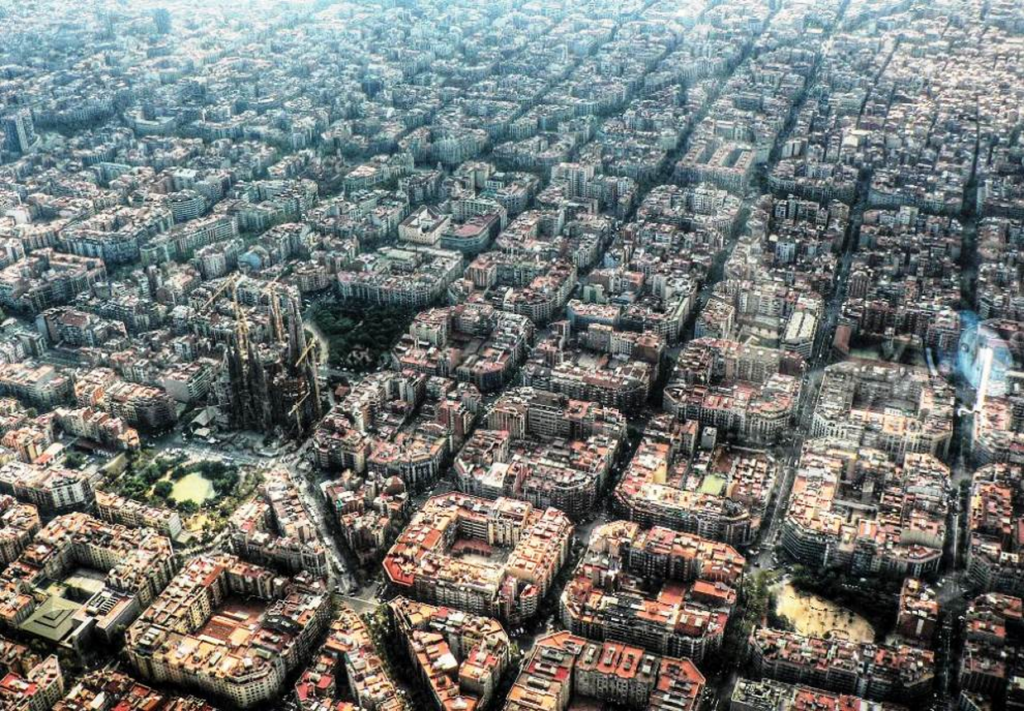
I’m a bit out of order this week. Here’s another in my series of aerial photos that I’ve hung onto for years, and never used in my fiction.
Google tells me this photograph is of Barcelona’s Eixample district, designed in the nineteenth century by urban planner Ildefons Cerdà.
Apparently, every one of those octagonal blocks was planned. The clipped corners were intended to improve visibility, airflow and access to sunlight. The famous Sagrada Família sits near the centre, rising out of the geometric pattern like a wild idea that escaped the drawing board.
All of which is interesting.
But when I first looked at the photograph, none of that was what struck me. What struck me was the density.
Look closely. Pick a single window. One tiny rectangle among thousands. That gives you a sense of scale. Those blocks aren’t abstract shapes. They’re homes. Apartments. Kitchens. Bedrooms. People living shoulder-to-shoulder in a way that feels almost unimaginable from my perspective.
My first reaction was that the neighbourhood looked more densely packed than anything I’ve ever seen in North America. Even New York City doesn’t have this level of regularity. Manhattan may have a grid, but it evolved building by building, decade by decade. It still feels organic.
This feels designed. Not just planned, but deliberately conceived as a complete system.
And yet the more I looked at it, the more my reaction began to change. Because modern North American cities have their own peculiarities.
For instance, Edmonton is a remarkably inconvenient city if you don’t own a car. We spread ourselves across vast distances. We prize personal space, private yards, detached homes and wide roads. We have room to breathe, but we often need a vehicle just to buy a loaf of bread.
Meanwhile, a district like Eixample is built around a completely different set of assumptions. People live close together. They walk. They encounter one another.
Community isn’t something that has to be organized and scheduled quite so aggressively because people are constantly crossing paths.
One of the great ironies of modern Western society is that we’re only now becoming aware of how important togetherness, community and social connection are to human well-being. Entire books are being written about loneliness and social isolation. Yet many older cities were accidentally solving those problems simply through their design.
At least, that’s what I suspect. Because here’s the curious thing. After staring at this photograph for far too long, I decided I wanted to see what life in Eixample actually looks like.
Not from a drone. Not from an airplane. From the sidewalk. From a café. From one of those mysterious courtyards in the centre of the blocks.
And that’s when I discovered something odd. I couldn’t find a single street-level photograph of the district.
Every image was another aerial view. Every article showed the same astonishing geometric pattern from high above. The world seems fascinated by the shape of Eixample, but not by what it feels like to live there.
It feels like looking at a cathedral roof and deciding you understand the cathedral.
Surely the experience on the ground must be completely different.
And then there are those courtyards. I didn’t even notice them at first. Only after studying the image did I realize that nearly every block contains an open interior space. Looking at the district from above, your eye is drawn to the streets and buildings. The courtyards almost disappear.
Yet for the people living there, those spaces may be the most important feature of all. They’re the hidden side of the city. The private face behind the public one.
I suspect that if I stood in one of those courtyards, surrounded by trees and neighbours and apartment balconies, my impression of Eixample would be entirely different from what I feel looking at this photograph.
And that may be the real lesson here.
Travel broadens the mind because it exposes us to different answers to questions we didn’t realize we were asking. How much personal space do we need? What makes a neighbourhood livable? How should cities be built? Where does community come from?
Looking at this photograph makes me appreciate my yard, my garden, and my view of a wide blue Alberta sky.
At the same time, it also makes me wonder what I might be missing.
Perhaps that’s why the image fascinates me so much. Not because it shows Barcelona, but because it reminds me that there are many ways to live, and that most of them look very different depending on whether you’re viewing them from thirty thousand feet up—or standing on the ground among the people who call that place home.

Now available for preorder:
Camlann
Latest releases:
Even More Time Kissed Moments
Before, After, Always
Kiss Across Time Box Three