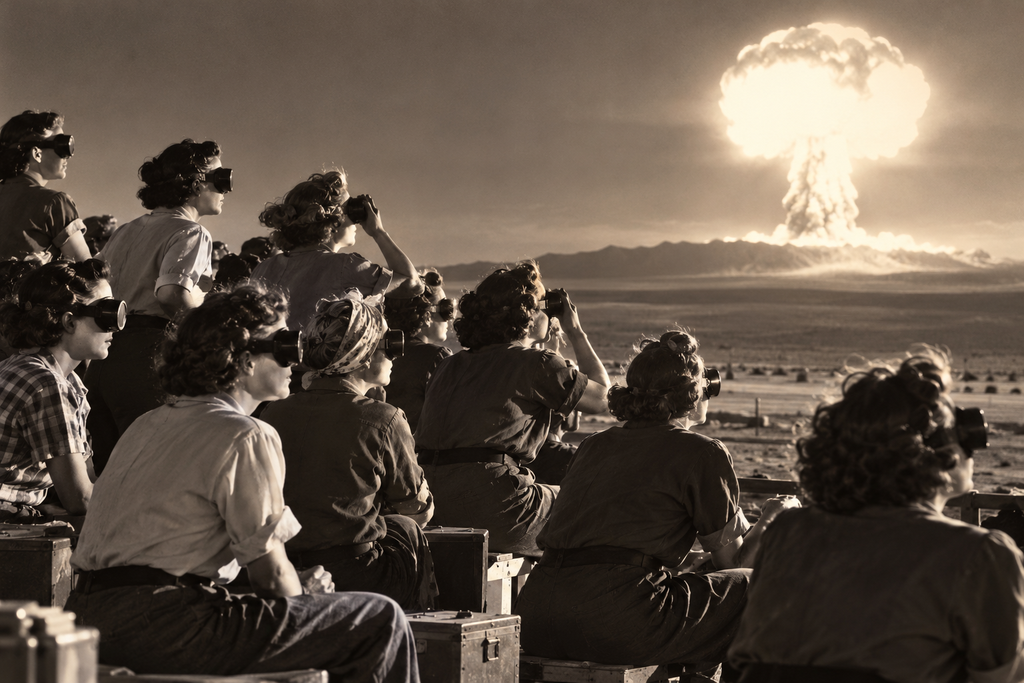
I watched Oppenheimer. So I thought I had a reasonably good idea of what life at Los Alamos looked like.
The scientists were men. Their wives came with them to this strange, hastily constructed secret town in the New Mexico desert, where they coped with primitive housing, babies, dust, rationing, laundry and the general business of making a home while their husbands disappeared every morning to build an atomic bomb.
That picture isn’t exactly wrong. It’s just missing rather a lot of women.
Because some of the people disappearing every morning to build the bomb were women, too.
Women worked on the Manhattan Project as physicists, chemists, mathematicians, biologists, computational analysts and technicians. They worked on nuclear chain reactions, plutonium chemistry, implosion, radiation monitoring and isotope separation.
And thousands more performed highly technical work without being told what they were actually making. I had no idea.
The Chemist Who Was Asked If She Could Type
Lilli Hornig actually appears briefly in Oppenheimer, although if you blink at the wrong moment you could come away from the movie without realizing how much she did. Hornig was a chemist.
Her husband, Donald Hornig, was recruited to Los Alamos, and Lilli went with him. When she arrived, however, one of the first questions she was asked was whether she could type. She pointed out that she had a chemistry degree.
Eventually, someone found a more appropriate use for her. Hornig went to work on plutonium chemistry. Then officials became concerned that plutonium exposure might damage women’s reproductive health, so women were removed from that work.
This concern for Lilli’s safety did not result in her being sent home to knit socks. She was transferred to work with high explosives. Yes, really.
Hornig went on to work on the explosive lenses required for the implosion bomb—the enormously difficult problem of arranging precisely shaped explosives so that they detonated inward simultaneously, compressing a plutonium core.
That was the system tested at Trinity and used in the bomb dropped on Nagasaki.
The movie gives Hornig a couple of good lines. History gave her rather more to do.
She Wasn’t the Only One
The popular image of the Manhattan Project tends to be a roll call of brilliant men: Oppenheimer, Fermi, Teller, Feynman, Lawrence, Bethe and so on. But women were in the laboratories, too.
Leona Woods was only twenty-three when she worked with Enrico Fermi’s team on Chicago Pile-1, the world’s first artificial nuclear reactor. She helped develop neutron detectors for the experiment and was present in December 1942 when the reactor achieved the first controlled, self-sustaining nuclear chain reaction.
Later, at Hanford, she was involved when the plutonium-production reactor unexpectedly shut down because of xenon poisoning—a problem serious enough to threaten plutonium production.
Floy Agnes Lee, a young biologist whose father was from Santa Clara Pueblo, worked in the hematology laboratory at Los Alamos. She collected and examined blood samples from scientists exposed to radiation and monitored people including Enrico Fermi. She later earned a doctorate in biology and eventually returned to work at Los Alamos.
Naomi Livesay was a mathematician who worked on calculations associated with the implosion problem.
Maria Goeppert Mayer worked on uranium isotope separation. She would eventually win the 1963 Nobel Prize in Physics for completely different work.
Then there was Charlotte Serber.
Oppenheimer recruited Serber to establish and run the technical library at Los Alamos. That may sound like a slightly more conventional woman’s job until you consider what this particular library contained: The scientific information required to design the world’s first nuclear weapons flowed through it.
Serber built the library from scratch, controlled highly classified documents and became the only female group leader at wartime Los Alamos.
Quite possibly the most terrifying answer in history to, “So, what sort of library do you run?”
“Can’t tell you.”
And Then There Were the Calutron Girls
The women at Oak Ridge, Tennessee, are where this story becomes extraordinary. The Manhattan Project needed enriched uranium. Natural uranium contains only a small proportion of uranium-235, the isotope needed for the uranium bomb. At Oak Ridge’s enormous Y-12 plant, electromagnetic machines called calutrons were used to separate U-235 from the much more common U-238.
Someone had to operate them. Enter approximately 10,000 young women, many of them fresh out of high school. They sat at control stations, watching gauges and making constant tiny adjustments to keep the machines operating properly.
They became known as the Calutron Girls.
The work required concentration and precision. In fact, the women became remarkably good at it. There was just one rather important detail their employers neglected to mention. They weren’t told what they were doing.
They knew they were contributing to the war effort. They knew their jobs were secret. They were told not to discuss their work, even with other employees. But they weren’t told that they were separating uranium isotopes. They weren’t told they were producing enriched uranium.
They weren’t told that the material they were helping create would become the fuel for an atomic bomb.
Workers who asked too many questions could simply disappear from the workplace.
The uranium enriched at Y-12 ultimately went into Little Boy, the bomb dropped on Hiroshima on August 6, 1945. For many of the women operating the machines, the news of Hiroshima was when they finally learned what they had been working on.
Imagine discovering the purpose of your job by hearing that an entire city had just been destroyed.
A City Full of Secrets
This is the part of the Manhattan Project that is difficult to grasp from the famous names alone.
It was enormous.
Los Alamos was only one part of it. Oak Ridge in Tennessee enriched uranium. Hanford in Washington produced plutonium. Research was conducted in Chicago and elsewhere. Tens of thousands of people worked on pieces of an undertaking whose full purpose was known to remarkably few of them.
Women were everywhere in that system. Some were scientists who knew precisely what problem they were trying to solve. Some were technicians who knew what their machines did but not why the work mattered. Some, like the Calutron Girls, performed one crucial step in a process they were deliberately prevented from understanding.
And yes, some were wives who had followed their husbands into secret communities and were trying to raise children, cook meals, wash clothes and create ordinary life under very peculiar circumstances.
Sometimes they were both wife and scientist.
That’s the part that seems to have slipped out of the familiar version of the story.
Even Oppenheimer Mostly Leaves Them Out
Which brings me back to the movie. Christopher Nolan made Oppenheimer in 2023, long after historians had begun recovering these women’s stories.
Lilli Hornig is there. Most of the others aren’t.
There were hundreds of women working at Los Alamos alone, including scientists in mathematics, physics, chemistry, biology and computational work. Yet if your knowledge of the Manhattan Project came primarily from Oppenheimer, it would be very easy to leave the theatre with essentially the same impression I did: Men built the bomb. Women lived with the men who built the bomb.
To be fair, Oppenheimer is a movie about J. Robert Oppenheimer, not a documentary about the entire Manhattan Project. A three-hour movie can only contain so much history, even if Christopher Nolan apparently considers three hours merely a good start.
But movies become part of our cultural memory. We see the laboratories filled with men and unconsciously file that image away as history. Which is why discovering the real women of the Manhattan Project is so startling.
They aren’t an obscure footnote someone has recently added to make the history more inclusive. They were already there. They were measuring radiation. Calculating implosions, handling plutonium, designing detectors. Operating isotope-separation equipment. Managing the scientific information on which the project depended.
And in the case of thousands of young women at Oak Ridge, they were helping manufacture the material for an atomic bomb without even being allowed to know that was what they were doing.
They didn’t need to be added back into the story. They just needed us to notice that they’d been there all along.
For pre-order:
<watch this space!>
Latest releases:
Scandalous Sirens Omnibus
Camlann
Even More Time Kissed Moments