I wasn’t going to write another Women in History post this week. Really, I wasn’t.
I’ve written quite a few of them lately, and while I love digging up women who have been overlooked, forgotten, or quietly shoved into the footnotes of history, I thought perhaps I should give the subject a rest for a few weeks.
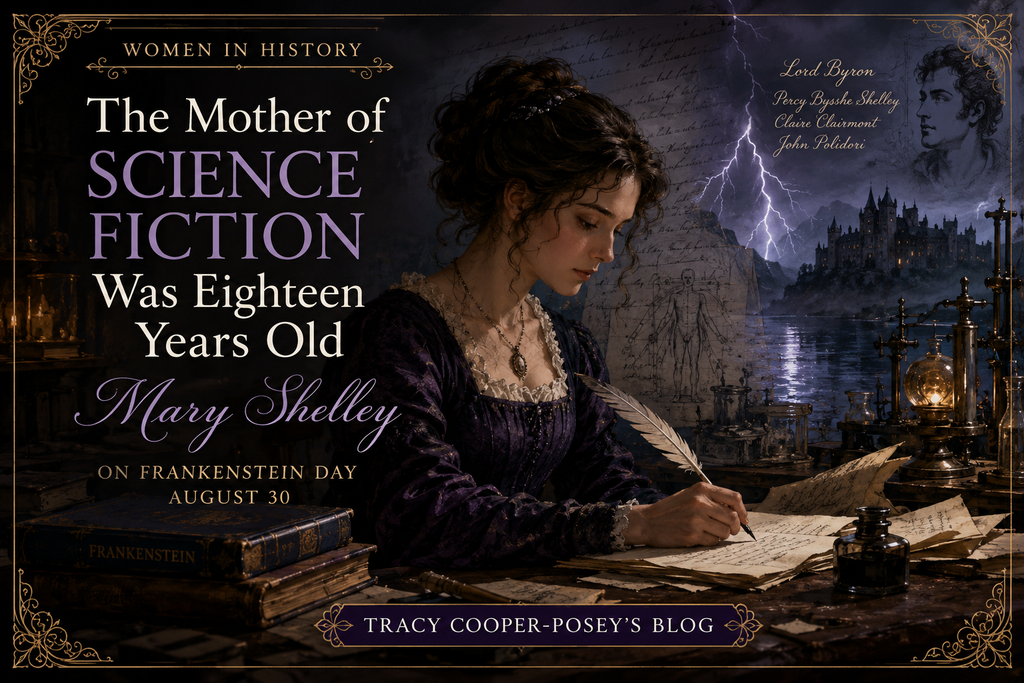
Then I checked the significant dates for today and August 30 is Frankenstein Day. Because August 30 is Mary Shelley’s birthday.
Oh, come on. Sometimes the universe doesn’t so much drop a hint as whack you over the head with it. Because Mary Shelley isn’t merely an interesting woman from history who happened to write a very famous book. She has a reasonable claim to having invented science fiction.
And she started writing Frankenstein when she was eighteen years old!
It Started With A Bunch Of Writers Stuck Indoors
The story of how Frankenstein came about is almost as famous as the novel itself, although I’d managed to get some of the details fuzzy in my head. In 1816, Mary Godwin—as she was then—was staying near Lake Geneva with Percy Bysshe Shelley, whom she would marry later that year.
Also nearby was Lord Byron, who was probably the most famous poet in Europe at the time, along with Mary’s stepsister Claire Clairmont and Byron’s personal physician, John Polidori.
And it rained. And rained. And rained some more.
1816 became known as the “Year Without a Summer,” thanks largely to the massive eruption of Mount Tambora the year before. The resulting atmospheric effects produced miserable weather across much of Europe.
So here was this collection of writers and intellectuals, trapped indoors by horrible weather, talking late into the night about ghosts and supernatural phenomena. Eventually Byron suggested they should each write a ghost story.
Mary couldn’t think of one. Which, as a writer, I find deeply reassuring. There she was, sitting in company with two famous male poets, challenged to produce something suitably horrifying, and her imagination apparently looked back at her and said: Nope. Got nothing.
Until it did.
Mary later described lying awake after one of their conversations and imagining a student kneeling beside the thing he had assembled, watching as it showed signs of life.
There it was. The seed of Frankenstein.
Percy encouraged her to develop the short tale into something longer, and by the following year she had finished the novel. Frankenstein; or, The Modern Prometheus was published on January 1, 1818. Mary Shelley was twenty years old.
And her name wasn’t on it.
The Anonymous Monster
The first edition of Frankenstein was published anonymously. Percy Shelley wrote the preface, which didn’t exactly help when readers began wondering who the author might be.
Mary’s name appeared on the second edition, published in 1823.
It’s tempting, looking back from two centuries away, to imagine that the book was ignored and Mary was only recognized as a genius much later, but that isn’t quite what happened.
Frankenstein attracted attention immediately. Reviews were mixed—sometimes spectacularly so—but people were reading it. By 1823, there was already a successful stage adaptation. The story had escaped. Rather like the creature itself, really. And it wasn’t going away.
What took much longer was our understanding of just what Mary Shelley had done.
Did Mary Shelley Invent Science Fiction?
There is no clean answer to “What was the first science fiction story?” Literary historians can argue about that one until Earth’s sun expands into a red giant, which would at least give the surviving science fiction writers excellent material.
There are certainly earlier candidates.
Margaret Cavendish’s The Blazing World, published in 1666, is often mentioned. There are ancient stories involving journeys to the moon and other fantastical ideas. It all depends upon where you draw the boundary around something that wasn’t even called “science fiction” until much later.
But Frankenstein has one enormous claim in its favour. Victor Frankenstein doesn’t wave a wand. He doesn’t summon a demon. He doesn’t discover that an ancient curse will reanimate the dead.
He uses science.
Mary takes the scientific thinking of her own time and asks one of the most fundamental questions in science fiction: What if?
What if a human being could create life?
Then she asks the even more important SF question: And what would happen if we did?
That’s the bit that makes Frankenstein feel astonishingly modern to me. The science itself isn’t the point. The consequences are.
Victor discovers a way to do something humanity has never done before. Then Mary explores the moral, emotional and social consequences of that breakthrough.
Artificial intelligence, genetic engineering, cloning, nuclear weapons, robots, time machines, faster-than-light travel… Science fiction has been asking variations upon Mary’s question ever since. Just because we can do something, what happens when we do?
And She Wasn’t Finished
Frankenstein wasn’t a one-off written by a teenager who then disappeared into her husband’s literary shadow.
Mary Shelley became a professional writer. She wrote novels, short stories, travel writing, biographies, essays and reviews. After Percy drowned in 1822, she also devoted considerable effort to preserving and publishing his work.
And in 1826, she published another novel that should make science fiction readers sit up. The Last Man. It’s set in the future. Human civilization is being destroyed by a global pandemic.
The novel follows the dwindling survivors as humanity approaches extinction.
She wrote that book in 1826.
Mary Shelley wasn’t accidentally a science fiction writer because Frankenstein happens to fit our modern definition of the genre. She went back and did it again.
Women Have Been In Science Fiction All Along
Science fiction has acquired a peculiar reputation as a male genre. Male writers. Male readers. Boys and their rockets and spaceships and robots.
Except women have been there from the beginning. Quite literally, if you accept Frankenstein as the beginning of modern science fiction. And they never went away.
There was C. L. Moore, writing science fiction and fantasy in the pulp magazines in the 1930s. Andre Norton, whose deliberately gender-ambiguous pen name helped her sell adventure fiction to a largely male readership. Judith Merril. Ursula K. Le Guin. Joanna Russ. James Tiptree Jr.—who was actually Alice Sheldon. Octavia Butler.
And Leigh Brackett.
Romance readers who have never knowingly picked up a science fiction novel in their lives may nevertheless know something Leigh Brackett helped write. The Empire Strikes Back.
Yes. That Empire Strikes Back.
Brackett was already an accomplished science fiction and screen writer when George Lucas hired her to write the first draft of the screenplay. She died shortly after completing it. Lucas substantially rewrote the script and Lawrence Kasdan later came aboard, but Brackett received screenplay credit on the finished movie.
So if you’ve watched Han and Leia sniping at each other while very obviously falling in love, you’ve encountered a female science fiction writer whether you knew it or not.
Women aren’t newcomers to SF. They weren’t admitted to the clubhouse sometime in the 1970s after proving they knew the secret handshake. They were already there.
Which Brings Me Back To Mary
There is something wonderfully appropriate about Frankenstein itself becoming bigger than anyone expected. Mary Shelley set out to write a ghost story because Lord Byron issued a challenge on a rainy summer night. She was eighteen. She was surrounded by men whose literary reputations towered over hers.
She couldn’t think of a story. Then she did.
Two hundred and ten years later, nearly everyone knows Frankenstein. They might mistakenly call the creature Frankenstein. They may know Boris Karloff’s square-headed, bolt-necked movie monster rather than Mary’s intelligent, articulate and desperately lonely creature. They may never have opened the novel.
But they know the story.
More importantly, writers are still asking the question Mary Shelley asked when she imagined a young man staring in horror at the life he had created: What if?
For a genre that supposedly belongs to men, science fiction has a rather inconvenient woman standing right at the beginning of it.
Happy birthday, Mary Shelley.
For pre-order:
<watch this space!>
Latest releases:
Scandalous Sirens Omnibus
Camlann
Even More Time Kissed Moments