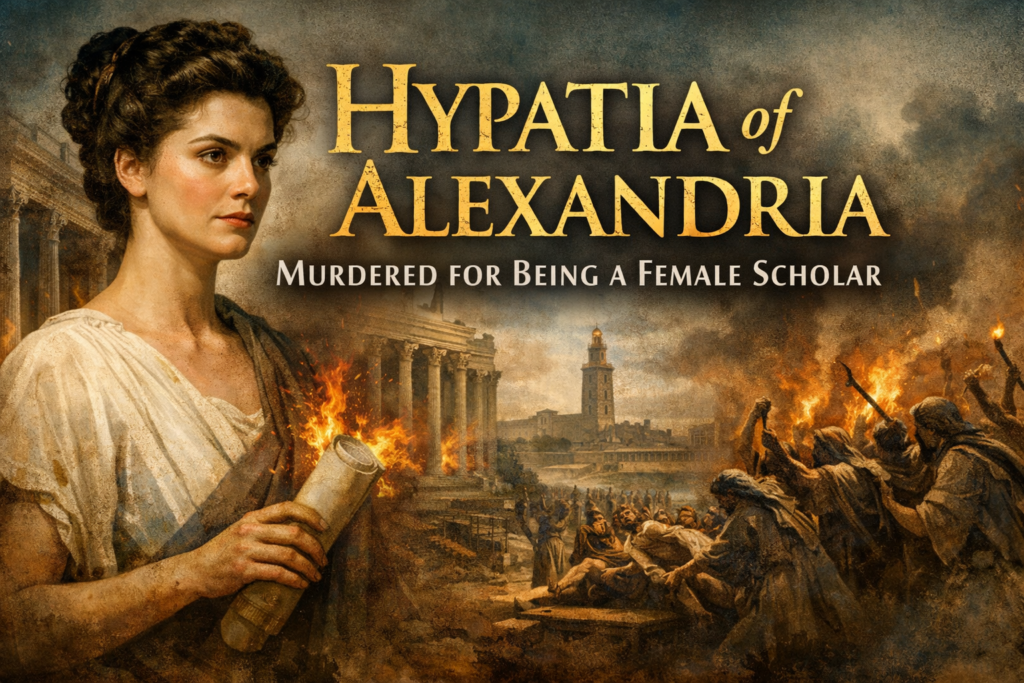
There are many ways to become dangerous.
You can lead armies. You can build empires. You can topple kings. Or—far more quietly—you can think.
Hypatia of Alexandria did the last of these. And it got her killed.
The Most Brilliant Mind in Alexandria
Hypatia lived in Alexandria around the late 4th and early 5th centuries CE, a time when the city was still one of the intellectual capitals of the world. This was the Alexandria of scholars, scrolls, and arguments that could last for days. She was a mathematician, astronomer, and philosopher—three disciplines that, even today, don’t often overlap. In her time, they were considered the highest forms of intellectual pursuit.
And she didn’t just study them. She taught them. Publicly. To anyone who wished to learn.
Men—many of them powerful—sat at her feet to hear her lectures. She advised politicians. She corresponded with intellectuals across the known world. She was, by all accounts, not just respected, but revered.
Pause for a moment and consider how extraordinary that is. A woman. In the 400s. At the center of intellectual life. That alone would have made her remarkable.
It also made her a target.
Knowledge Is Never Neutral
Hypatia lived in a time of escalating tension. Alexandria was not just a city of ideas—it was a city of factions. Pagan traditions, rising Christianity, political rivalries…all of it was tangled together in ways that made disagreement dangerous. And Hypatia stood right in the middle of it.
Not because she chose sides. But because she refused to. She was known for her rationality, her commitment to knowledge, and her independence. She advised Orestes, the Roman governor of Alexandria, who was locked in a bitter power struggle with Cyril, the city’s Christian bishop. That alone would have been enough to draw suspicion.
But Hypatia represented something even more unsettling: a woman who could not be controlled by any faction. She didn’t preach. She didn’t convert. She didn’t yield. She thought.
The Murder That Shocked the Ancient World
In 415 CE, a mob of religious extremists intercepted Hypatia in the street. They dragged her from her chariot. They took her to a church. And there, they murdered her—brutally, publicly, and with a fury that suggests this was not just political violence, but something more visceral.
Something personal.
Her death sent shockwaves through the ancient world. Even in a time accustomed to violence, this stood out as an atrocity. Because everyone understood what it meant. This wasn’t just the killing of a political advisor. It was the silencing of a mind.
Why Hypatia Still Matters
Hypatia has become a symbol over the centuries—but not in a vague, dusty, historical way. She represents something very specific: The danger of knowledge. Not knowledge itself, but what it does.
It questions authority. It disrupts certainty. It refuses to sit quietly in the corner and behave. And when that knowledge comes from someone society expects to be silent—a woman, especially—it becomes even more threatening.
Hypatia didn’t set out to be a rebel. She simply refused to be anything less than what she was: a thinker.
Yes—Agora Told Her Story (Sort Of)
If you’re remembering Agora—yes, that’s her. Played by Rachel Weisz, Hypatia’s story was brought to the screen with all the visual weight and tragedy it deserves. The film takes liberties (as all films do), but it captures something essential: The isolation of being the only person in the room asking questions no one wants asked. And the cost of that isolation.
It also leans heavily into the destruction of knowledge—the burning of libraries, the collapse of intellectual life—which, while historically debated in its specifics, is emotionally and thematically accurate. Because Hypatia’s death did mark a turning point.
Not the end of knowledge. But the end of an era where it could exist, openly and freely, in places like Alexandria.
The Quiet Kind of Courage
We often think of courage as loud. Battlefields. Speeches. Dramatic defiance. Hypatia’s courage was quieter. She taught. She studied. She continued, even as the world around her grew more volatile.
There’s something almost unbearably poignant about that—this belief that reason, learning, and conversation would be enough to hold the line. They weren’t. But that doesn’t make her wrong. It makes her human.
Strong Women in History Don’t Always Win
And this is the part that makes Hypatia linger. She didn’t triumph. She didn’t escape. There’s no satisfying ending here. Only the uncomfortable truth that sometimes, being brilliant, principled, and unyielding doesn’t save you. Sometimes, it’s exactly what puts you in danger.
Yet we remember her. More than we remember the men who killed her.
And that, perhaps, is its own kind of victory.

Now available for preorder:
Even More Time Kissed Moments
Camlann
Latest releases:
Before, After, Always
Kiss Across Time Box Three
The Grail and Glory