A few weeks ago, I posted an aerial photo of Mina in Saudi Arabia, which looked like a temporary city dropped into the desert by aliens with obsessive-compulsive tendencies.
This photo gives me the same awe-struck feeling, but for completely different reasons.
This is Malé, the capital city of the Maldives:
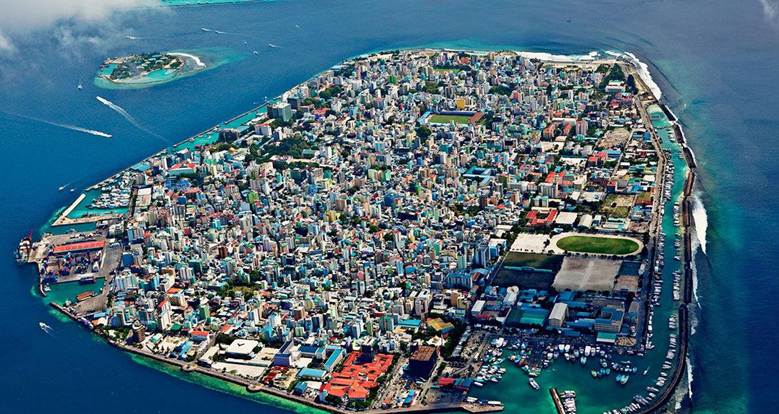
The sheer density of it makes my brain itch. (And I just love that they used up many meters of precious land with a cricket arena — the green oval on the right).
This image, above, is the one that has stayed tucked in my notebook for years. I found more of them online:
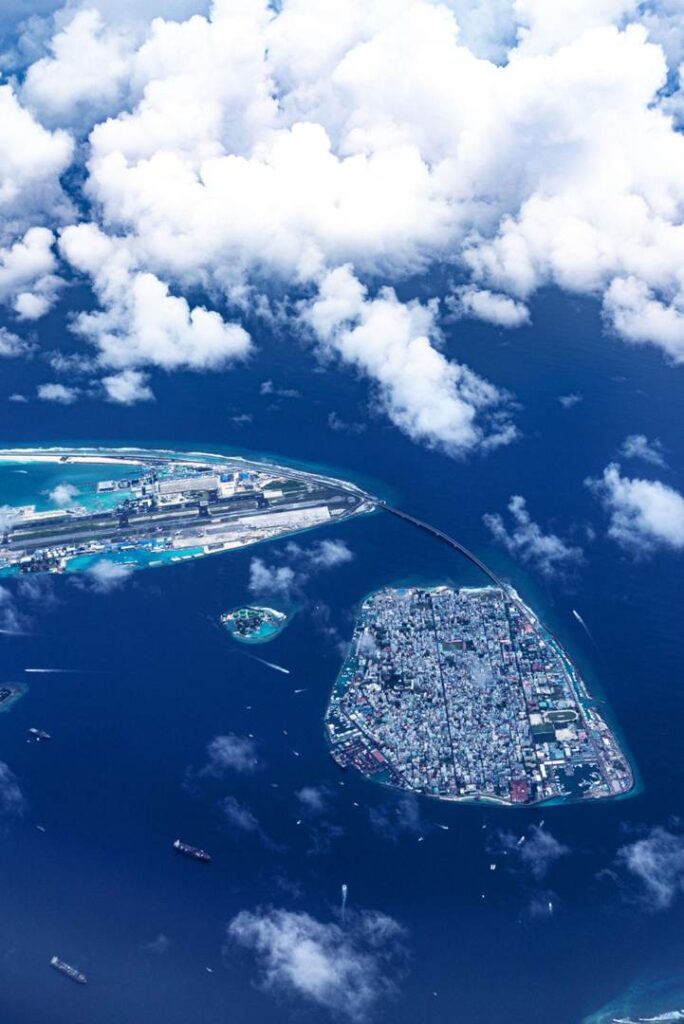
This one shows the bridge across to the international airport, another island packed tight with human structures, but these are larger in scale and make the main city look tiny.
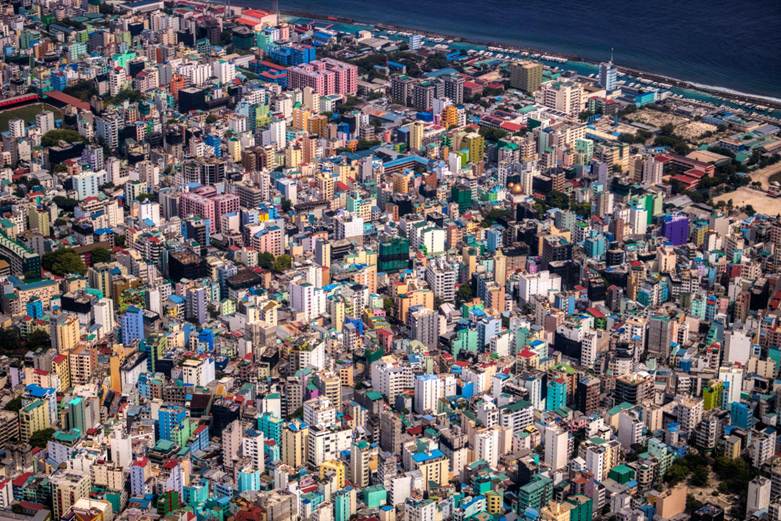
Honestly, this looks even more dense and packed in than images of New York city….
The entire city occupies roughly one square mile. Around 200,000 people live there. Every possible inch appears to have been used. Buildings shoulder up against each other with barely enough room left for streets. Boats are packed around the perimeter like someone ran out of table space halfway through setting up a board game.
And unlike Manhattan, which at least has the psychological comfort of being attached to a much larger landmass, Malé sits out there in the middle of the Indian Ocean like a concrete lily pad.
There’s something faintly unreal about it.
The Maldives itself averages only about one metre above sea level. One metre. Meanwhile, Edmonton sits at roughly 645 metres above sea level, which means if the oceans rise high enough to threaten Edmonton, we all have much larger problems than real estate values.
Looking at this photo, though, you can see immediately why climate change discussions hit differently in the Maldives. There’s no higher ground to retreat to. No hills. No inland migration. The ocean is right there, pressing against the seawalls on every side.
It gives the city a strange fragility.
Human beings are astonishing creatures when it comes to where we decide to build cities. We put them in deserts, earthquake zones, floodplains, frozen wastelands, hurricane corridors, on the slopes of active volcanoes and tiny coral islands barely sticking out of the sea, then spend centuries insisting this is all perfectly sensible.
But writers love cities because cities are concentrated human pressure. Put enough people into one place and stories happen automatically.
Which is probably why this photo lodged itself in my head years ago.
I actually did use Malé in a science fiction novel series, under my Cameron Cooper pen name. In the Iron Hammer series, the central government of humanity is located on this island in the far future. Spaceships land on the next island over, connected by a bridge.
Only by then, humanity is mostly gone. The island has returned to palms and sand. The government operates out of bamboo houses instead of concrete towers.
That contrast fascinated me even more than the real city does. Because when you look at this photo, it feels impossible to imagine the island empty. Human beings have packed every metre of it with evidence of themselves. Concrete, docks, apartment towers, seawalls, harbours.
Yet history says cities vanish all the time. Sometimes they burn. Sometimes trade routes shift. Sometimes the climate changes. Sometimes people simply leave.
Science fiction has always loved ruined cities. But there’s something especially haunting about imagining the disappearance of a city that barely has room to exist in the first place.
Maybe that’s the real awe-factor here.
Not the density. The fragility.

Now available for preorder:
Camlann
Latest releases:
Even More Time Kissed Moments
Before, After, Always
Kiss Across Time Box Three
I am sometimes astonished at the way humans decide to make cities. New Orleans being below sea level has always astonished me. Interesting that city trusts barriers to keep the ocean at bay. Detroit astonished me because Grand River RD was actually a river until they filled it in and made it a road. I always wondered why people did that. Humanity sure loves living near an ocean, a lake or a river.
Rivers and seas, and even lakes, were trade routes, before roads were built. And rivers were fresh water — so were lakes (ugh!). Lots of reasons why cities are where they are. Why people live there is often “because my family does.” They self-perpetuate.
I do wonder how much global warming will make that redundant and people are forced to migrate elsewhere….
Tracy